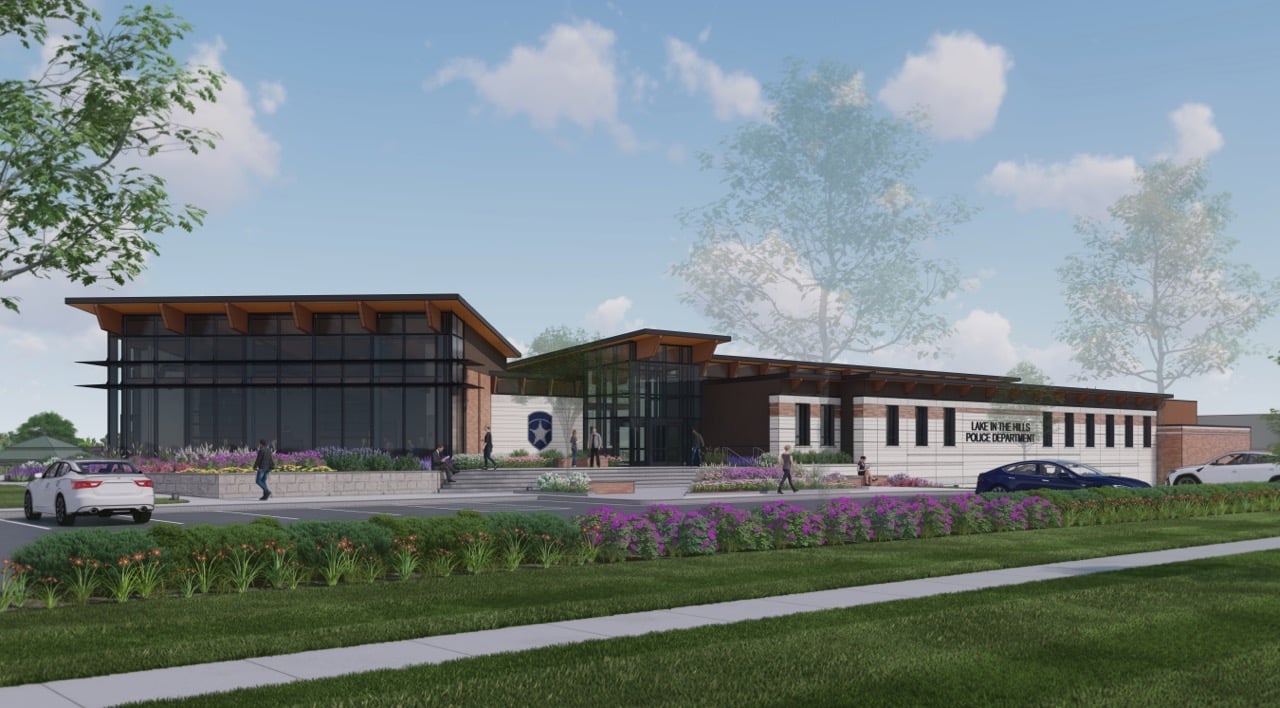
The new Lake in the Hills police station sets a new standard for public safety facilities
By Tino Kalayil
Communities are starting to build again, moving beyond incremental upgrades toward investments designed for the long haul.
Identifying the need hasn’t been the issue. Finding a path forward has. Years of deferred maintenance, rising construction costs and uncertainty around funding all play into why projects stall, perpetuating a costly cycle of short-term fixes.
Any way you slice it, moving from concept to construction is a heavy lift. Breaking that inertia is often the hardest part.
A renewed focus on long-term performance has helped Illinois communities to take the plunge, tying those decisions to lower, more predictable operating costs. Through that lens, projects that once felt out of reach begin to feel tangible.
In Lake in the Hills, a northwest suburb of Chicago, that shift takes shape in a new police facility completed in February. The roughly $27 million project replaces a building from the early 90s that had long since outlived its useful life.
The city did everything it could to squeeze a few more years of service out of the existing station. But there was only so much that could be done. At a certain point, the limitations were clear.
“There’s no question upgrades have been needed for a long time,” said Peter Stefan, the town’s finance director. “Retrofitting the station over the years was a temporary stopgap. This new facility is designed to last for decades.”
That reality isn’t unique. Across Illinois, aging public buildings are creating a growing backlog of deferred maintenance. Public universities alone face more than $8 billion in needed repairs, reflecting the condition of aging facilities stretched beyond their intended purpose. Capital programs such as the state’s Rebuild Illinois initiative point to a broader push to modernize public facilities.
A 2019 spatial analysis confirmed what staff already knew. The existing facility could no longer support modern policing functions, from evidence processing to accessibility requirements. The new building, at nearly 40,000 square feet, more than doubles the department’s previous footprint.
Of course, upfront cost still matters, but it’s increasingly weighed alongside how buildings perform over time. Owners can expect cumulative operating and maintenance costs to exceed the sticker price.
For Elmhurst-based architectural firm, Dewberry, public safety work is a core focus. Understanding how these settings function day to day informs every decision around layout, durability and long-term use.
“It’s less about any one material and more about how the whole building performs holistically,” said Dewberry’s Jeffrey Keppler, pointing to long-term maintenance and cost as key drivers.
While every design has its own identity, the structural system ultimately determines how the building performs. “You get a lot of efficiency from materials that serve a dual role as both structure and finish,” Keppler says. Not having to repaint or patch drywall on a regular basis improves the overall cost equation.
“We’re in the business of designing 50-plus-year buildings,” Keppler said. “We take a great deal of pride knowing that Lake in the Hills is set for whatever the future holds.”
Beyond durability, Keppler notes a seismic shift in how facilities like this are conceived. “A police station must meet strict operational and security requirements, but that doesn’t mean you’re confined to an institutional look and feel.”
The team at Dewberry was intent on maintaining a humane, welcoming environment. Natural light plays a central role, with clerestory windows bringing daylight into core areas of the building. Earthen materials and textures add depth, with subtle ties to the region’s natural landscape.
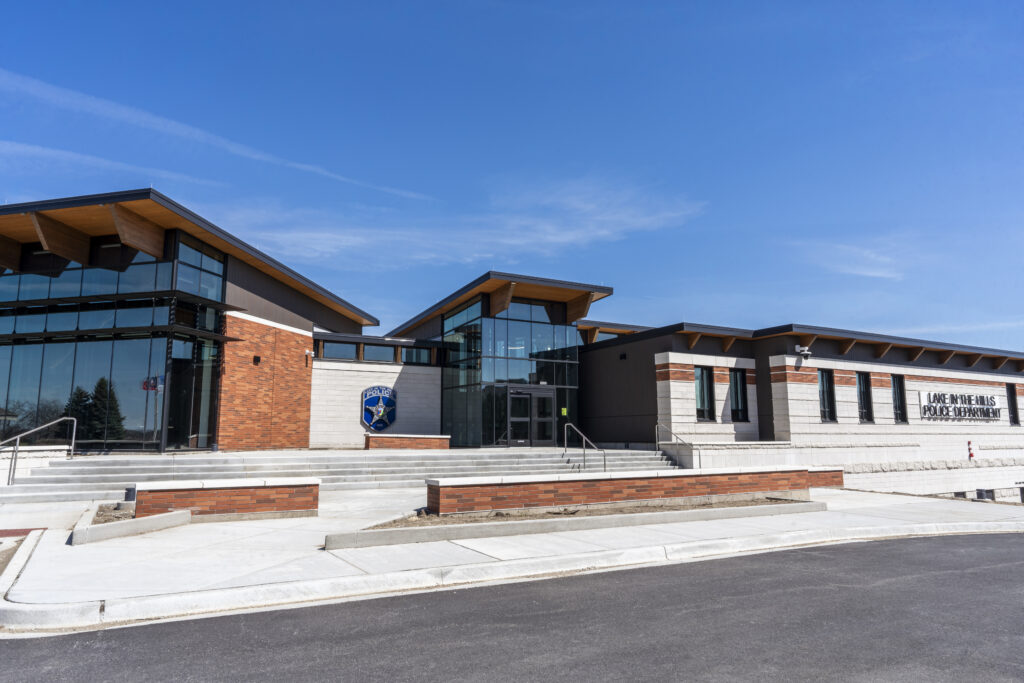
Keppler also credits the masonry contractor with translating that vision into built form, where the exterior combines multiple unit sizes and textures that connect to the site’s underlying ecology.
That expression is achieved in part using locally sourced Cordova Stone in a limestone color, a lower cost alternative to natural or cast stone. A mix of ground- and chisel-face blocks in varying sizes introduces dimension and shadow across the façade while providing long-term durability.
Step inside and that balance between design intent and performance continues.
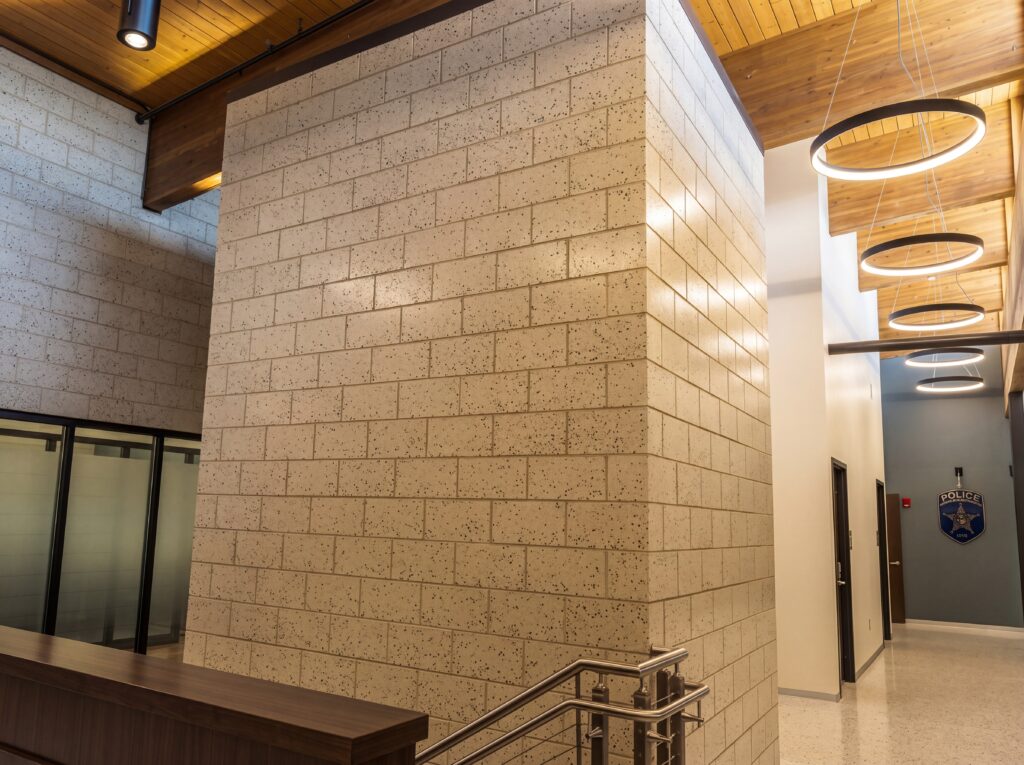
Dewberry set its sights on a specific interior palette—something luminous that would allow light to play across the space while complementing a range of browns and tans.
“So we created one!” said Northfield Block’s Phil Santoro. The company’s lab in Morris developed a custom mix combining brown and clear recycled glass to achieve the desired hue. “This ‘Pilsner’ block allows the space to really shine,” he added, while also supporting a durable, low-maintenance finish aligned with the project’s long-term performance goals.
None of this happens by accident. The new Lake in the Hills facility shows how a clear vision, close coordination across teams and a focus on long-term performance can move projects forward.
For teams looking to apply a similar approach, resources like the Block Design Collective offer early-stage guidance and technical support. The program is fully funded and available at no cost or obligation to help evaluate whether CMU aligns with your project’s goals.
About the author:
Tino Kalayil leads the Block Design Collective (BDC), a resource for builders and design teams looking to balance performance, cost and long-term value. Learn more at blockdesign.org or contact Tino at tkalayil@blockdesign.org.