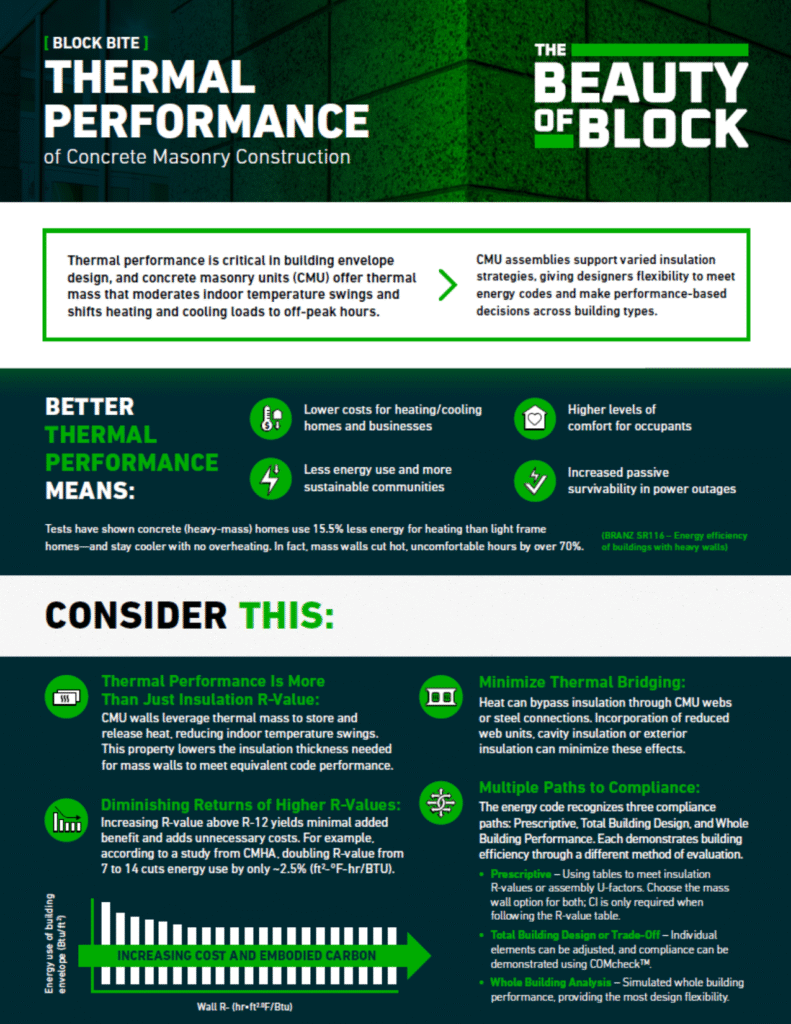
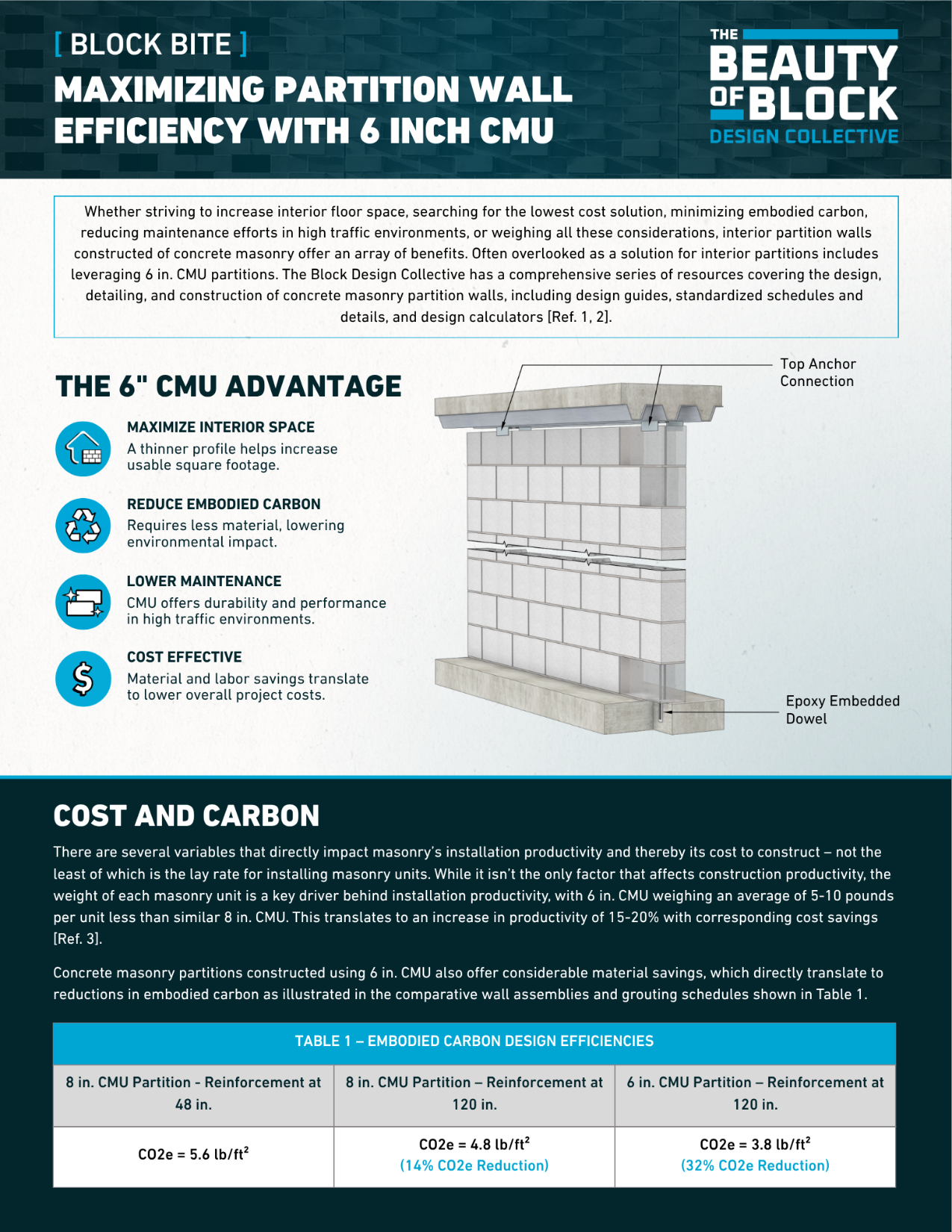
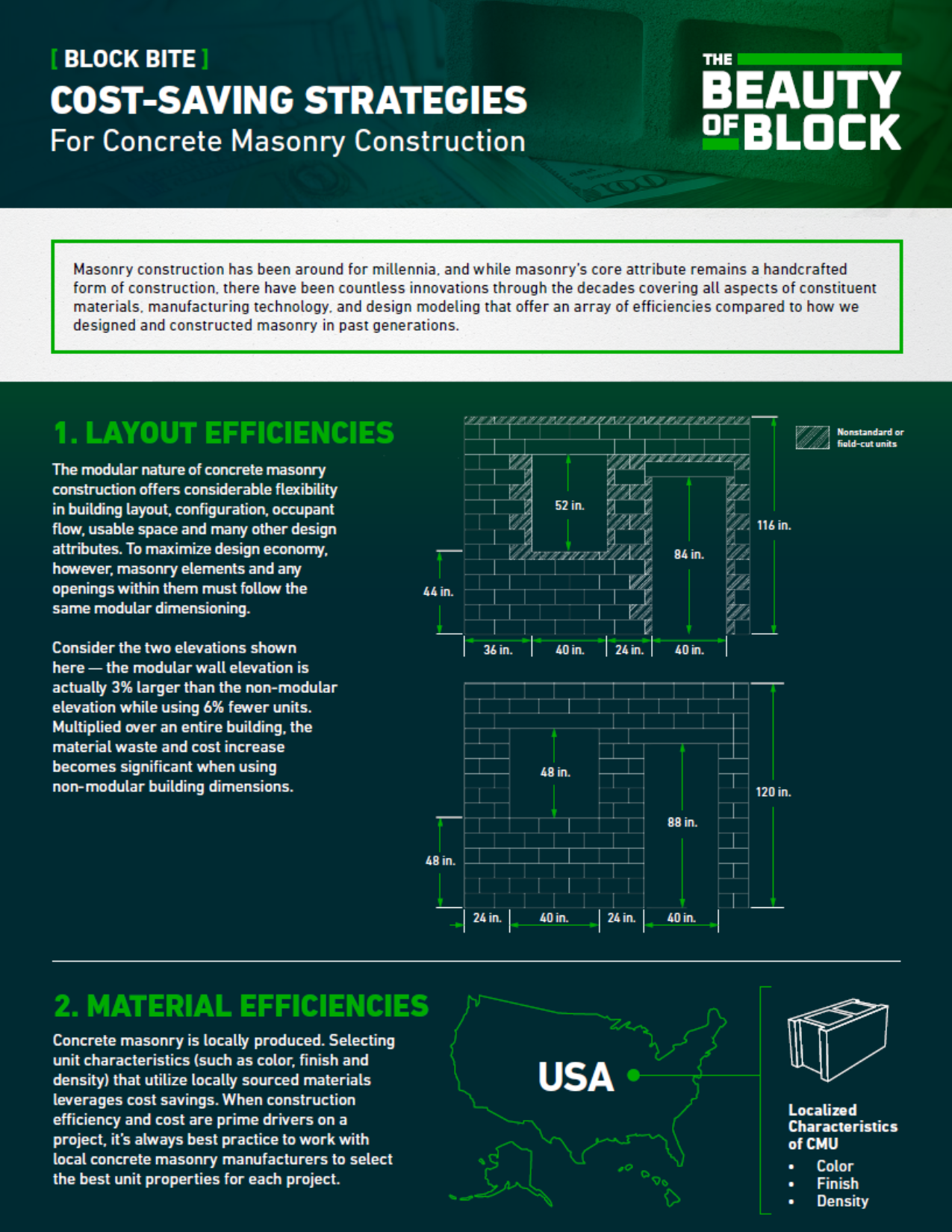
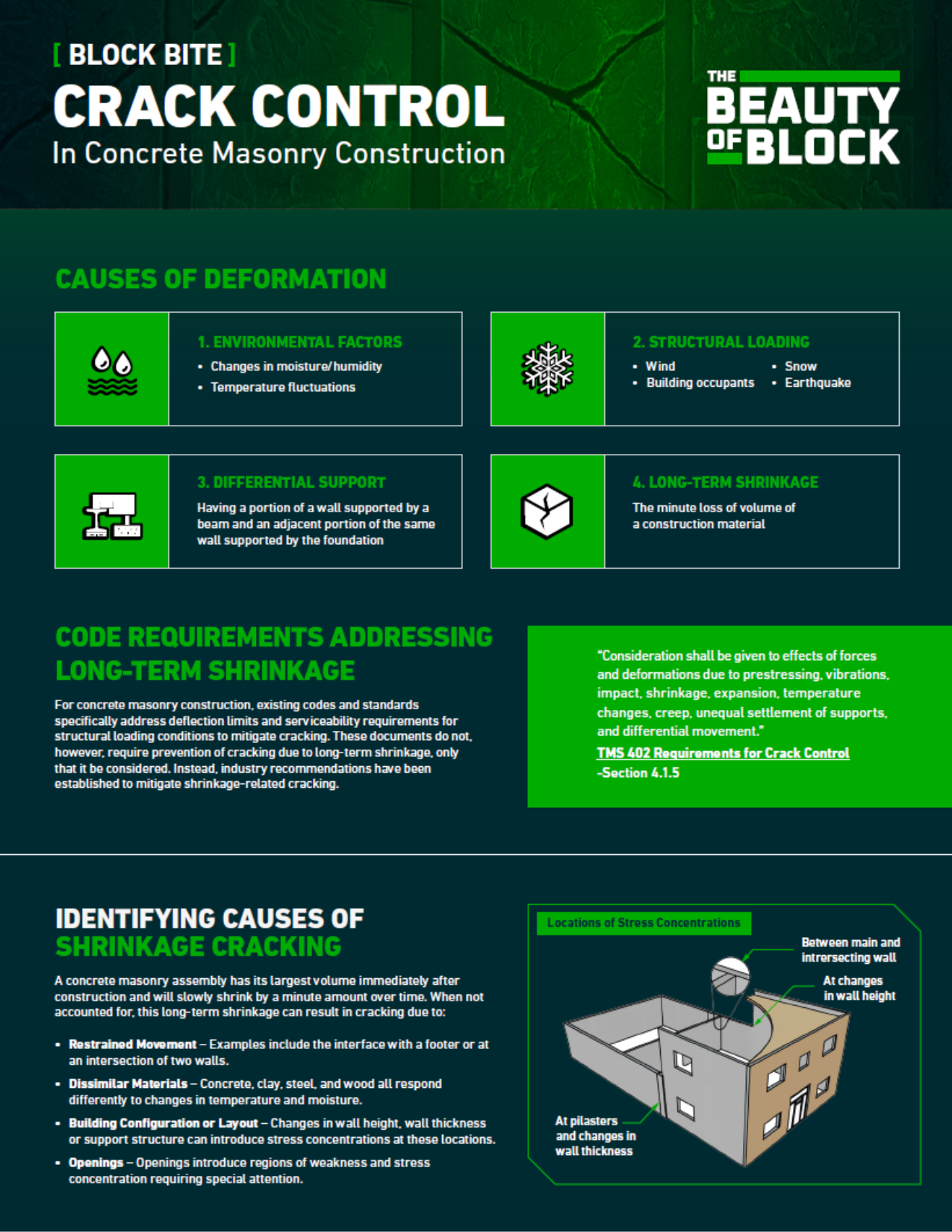
Thermal performance is critical in building envelope design, and concrete masonry units (CMU) offer thermal mass that moderates indoor temperature swings and shifts heating and cooling loads to off-peak hours. CMU assemblies support varied insulation strategies, giving designers flexibility to meet energy codes and make performance-based decisions across building types.
BETTER THERMAL PERFORMANCE MEANS:
- Lower costs for heating/cooling homes and businesses
- Less energy use and more sustainable communities
- Higher levels of comfort for occupants
- Increased passive survivability in power outages
Tests have shown concrete (heavy-mass) homes use 15.5% less energy for heating than light frame homes—and stay cooler with no overheating. In fact, mass walls cut hot, uncomfortable hours by over 70%. (BRANZ SR116 – Energy efficiency of building with heavy walls)
CONSIDER THIS:
Thermal Performance Is More Than Just Insulation R-Value:
CMU walls leverage thermal mass to store and release heat, reducing indoor temperature swings. This property lowers the insulation thickness needed for mass walls to meet equivalent code performance.
Diminishing Returns of Higher R-Values:
Increasing R-value above R-12 yields minimal added benefit and adds unnecessary costs. For example, according to a simple study from CMHA, doubling R-value from 7 to 14 cuts energy use by only ~2.5 (ft2-°F-hr/BTU).
Minimize Thermal Bridging:
Heat can bypass insulation through CMU webs or steel connections. Incorporation of reduced web units, cavity insulation or exterior insulation can minimize these effects.
Multiple Paths to Compliance:
The energy code recognizes three compliance paths: Prescriptive, Total Building Design, and Whole Building Performance. Each demonstrates building efficiency through a different method of evaluation.
- Prescriptive – Using tables to meet insulation R-values or assembly U-factors. Choose the mass wall option for both; CI is only required when following the R-value table.
- Total Building Design or Trade-Off – Individual elements can be adjusted, and compliance can be demonstrated using COMcheck™.
- Whole Building Analysis – Simulated whole building performance, providing the most design flexibility.
BUILT-IN PERFORMANCE OF CMU
Built-in Thermal Mass:
CMU absorbs and slowly releases heat, reducing temperature swings and shifting heating and cooling loads to off-peak hours, improving energy efficiency without added insulation.
Flexible Insulation Strategies:
CMU walls allow for the option to locate insulation on the exterior, interior or integral within the assembly. Designers can tailor assemblies to balance performance, budget and constructability.
Supports Passive Solar Design:
CMU’s inherent thermal mass makes it ideal for passive solar strategies. CMU walls absorb heat during the day and release it slowly during the night, improving comfort, dampening temperature fluctuations and reducing operational energy demand.