By Tino Kalayil, Technical Director of the Central Region for the Concrete Masonry Checkoff’s Block Design Collective
In the Twin Cities, where building performance expectations are high and budgets are tightly managed, it’s not just about delivering strong design. It’s also about doing it faster, providing more efficient delivery and with fewer costly surprises. Yet many project teams may not realize one of the most effective ways to streamline delivery and improve outcomes: delegated design (or assisted design).
Michigan has shown just how effective the delegated design approach can be when designing complex systems like concrete masonry (CMU) walls. With support from the Masonry Institute of Michigan (MIM), design and construction teams in Michigan have embraced the approach, helping streamline timelines, reduce costs and boost performance — all without overwhelming the core design team.
For Minnesota teams navigating comparable conditions, it’s a model that can have similar payoffs.
Delegated Design Works Smarter, Not Just Harder
In a typical delivery model, the architect of record (AOR) guides the overall vision and design, while the engineer of record (EOR) develops the supporting structural systems. Delegated design brings in a focused expert — a specialized structural engineer — to take ownership of the particular portion of the project. That approach works well with CMU wall assemblies and building systems.
The AOR and EOR still guide the vision and oversee performance, but the most technical details of CMU, like reinforcement, wall height, lateral loads, energy performance and moisture control, are now handled by someone who optimizes them for constructability and code compliance.
This approach helps avoid overdesign, which can drive up material costs and slow approvals. Additional efficiencies are recognized as delegated engineers work in parallel with other trades, producing coordinated shop drawings that reflect both structural intent and field realities. That means fewer RFIs, fewer delays and faster mobilization for masons.
Real-World Results: Michigan’s Success With Delegated Design
But how impactful can it really be? Philippe Ledent, the Executive Director of MIM, has seen firsthand the success it has driven, especially on complex, CMU-intensive projects.
“The MyMichigan Medical Center in Alpena is a 97,500-square-foot patient tower that used load-bearing CMU as part of its structural system paired with multiple masonry materials across the facade,” says Ledent.
“The project was valued at $63.5 million and required tight integration from day one. Through collaboration with Three Rivers Corporation (AOR), Fishbeck (architect and structural engineer), and a number of MIM’s members, the team prioritized early coordination and erected a complex façade with numerous intersections without a single issue thanks to delegated CMU design and real-world buildability.”
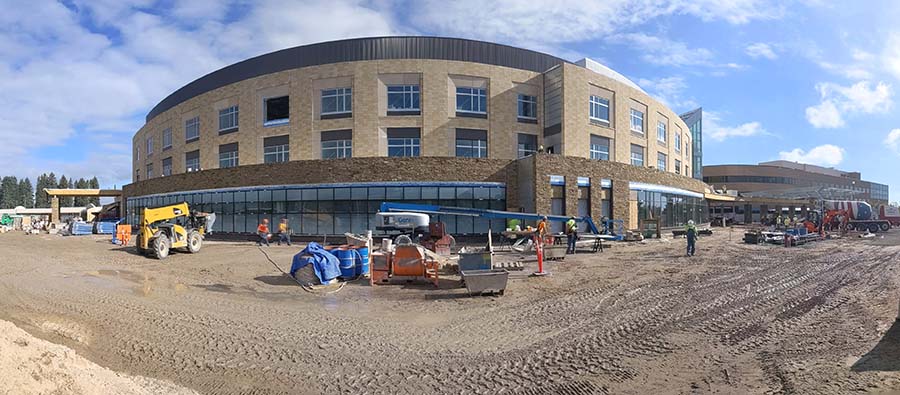
MyMichigan Medical Center Alpena/Masonry Institute of Michigan | Image credit: Three Rivers Corporation
Another Michigan example showcases how design assist can help pay off in both time and dollars. Tri County was requesting bids to build a K–5 school building for their school district. Originally bid with precast concrete for the exterior, MIM member, JK Masonry, Inc. proposed a voluntary alternate using load-bearing CMU, including insulation, wood blocking and cast-in-place lintels. The switch simplified coordination and saved the district an estimated $500,000 to $750,000, while also shaving months off the schedule.
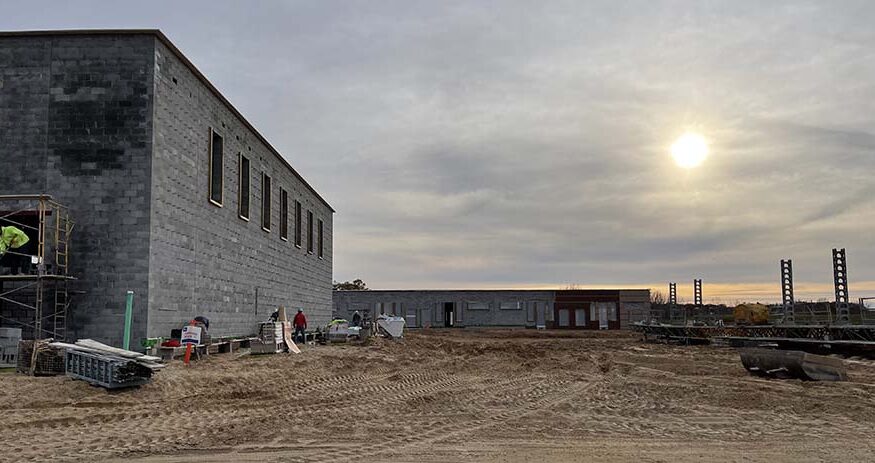
Tri County Elementary School Building/JK Masonry, Inc. | Image credit: Philippe Ledent
Built for Minnesota, Designed for Durability and Efficiency
With the same climate and building demands, Minnesota faces similar challenges as Michigan when building. CMU must do more than support loads here. Building projects must handle the harsh winter environment, reduce thermal bridging and meet energy codes.
By using the delegated design approach, delegated engineers can tailor their designs to these regional demands, delivering resilient, efficient walls without unnecessary cost or complexity. It clarifies responsibilities, simplifies decisions, sharpens detailing and helps CMU systems deliver on their full potential.
In a region where every hour and dollar counts, it’s a quiet advantage for everyone in the Minnesota construction industry that can net some powerful results.
Have a question about delegated design and CMU?
The Block Design Collective offers free project support to architects, engineers, and developers and can help answer your CMU-specific questions. For more information, contact Tino Kalayil at tkalayil@blockdesign.org or visit beautyofblock.com.
Tino Kalayil is the Technical Director of the Central Region for the Concrete Masonry Checkoff’s Block Design Collective. In his role, he leads a team of design experts dedicated to supporting architects and engineers with tailored solutions.