
Controlling Cracking and Movement in CMU Structures & Veneers
This presentation introduces concrete masonry by reviewing its aesthetic options, primary sustainability drivers, and common wall assembly types. It explains the main causes of movement and cracking in CMU walls and veneers, including structural loading, excessive deflection, differential settlement, differential movement, and shrinkage. Crack control strategies are considered such as using joint reinforcement, control joints, and relief joints. It concludes with detailing examples for openings, banding, shelf angles, corners, bond beams, and other common locations where movement must be accommodated.
Architectural Concrete Masonry: Single-Wythe Walls
This course introduces the design and performance fundamentals of architectural single-wythe concrete masonry. Participants will explore how concrete masonry’s inherent durability, resilience, thermal mass, and low-embodied-carbon contribute to high-performing building envelopes. The program explains key strategies for moisture management—including surface protection, integral water repellents, flashing, weeps, and crack-control detailing to keep single-wythe CMU walls dry and long-lasting. Learners will examine energy-code compliance pathways for mass walls, insulation options, and how density, thermal mass, and assembly configuration influence energy performance. The course concludes with practical guidance on air and vapor barriers, utilities, sample panels, and cleaning procedures to ensure high-quality outcomes in architectural CMU projects.
Architectural Concrete Masonry: Veneers & Cavity Walls

Architectural concrete masonry anchored veneers combine beauty, durability, and low maintenance while offering architects significant design flexibility. This course examines the finishes, sizes, profiles, and colors that distinguish architectural CMU, and explores the high performance these systems achieve when coupled with concrete masonry cavity walls. Participants will review essential detailing recommendations for veneers, including how to accommodate openings, flashing, anchoring, and crack control strategies. The session also covers energy performance benefits, thermal mass advantages, and cavity wall insulation strategies, while emphasizing quality assurance through sample panels. The course finishes with discussing cleaning recommendations for architectural masonry.
Crack Control in Concrete Masonry Construction
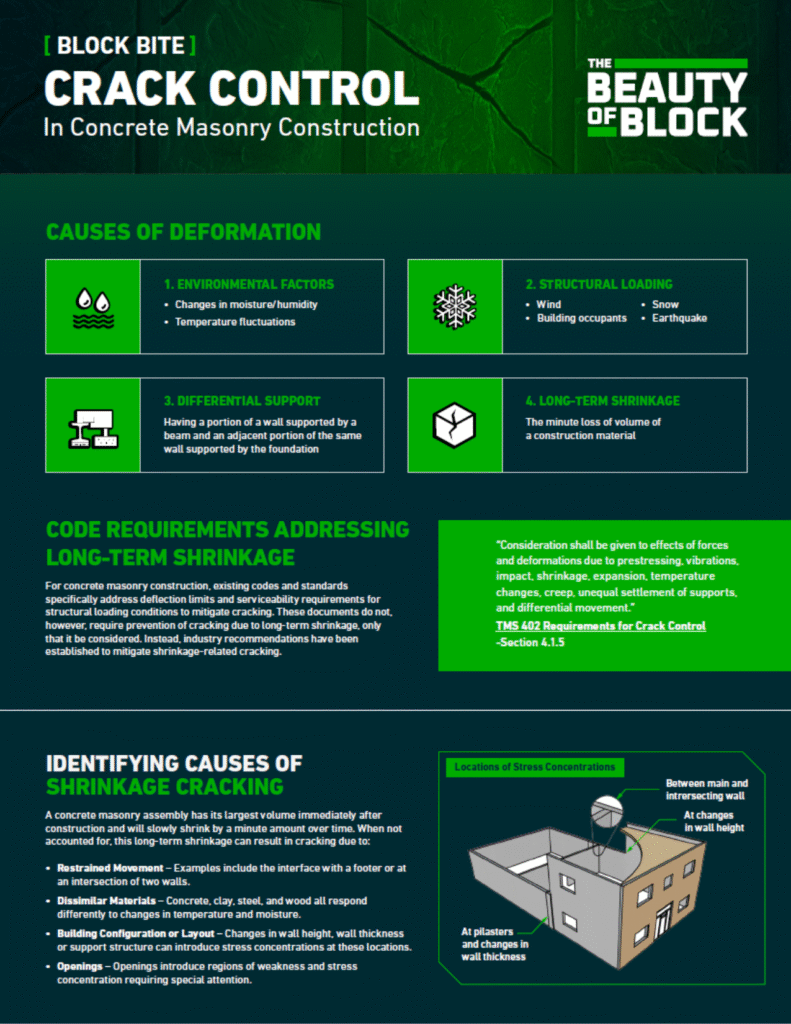
For concrete masonry construction, existing codes and standards specifically address deflection limits and serviceability requirements for structural loading conditions to mitigate cracking. These documents do not, however, require prevention of cracking due to long-term shrinkage, only that it be considered. Instead, industry recommendations have been established to mitigate shrinkage-related cracking.
Crack Control Strategies for Concrete Masonry Construction
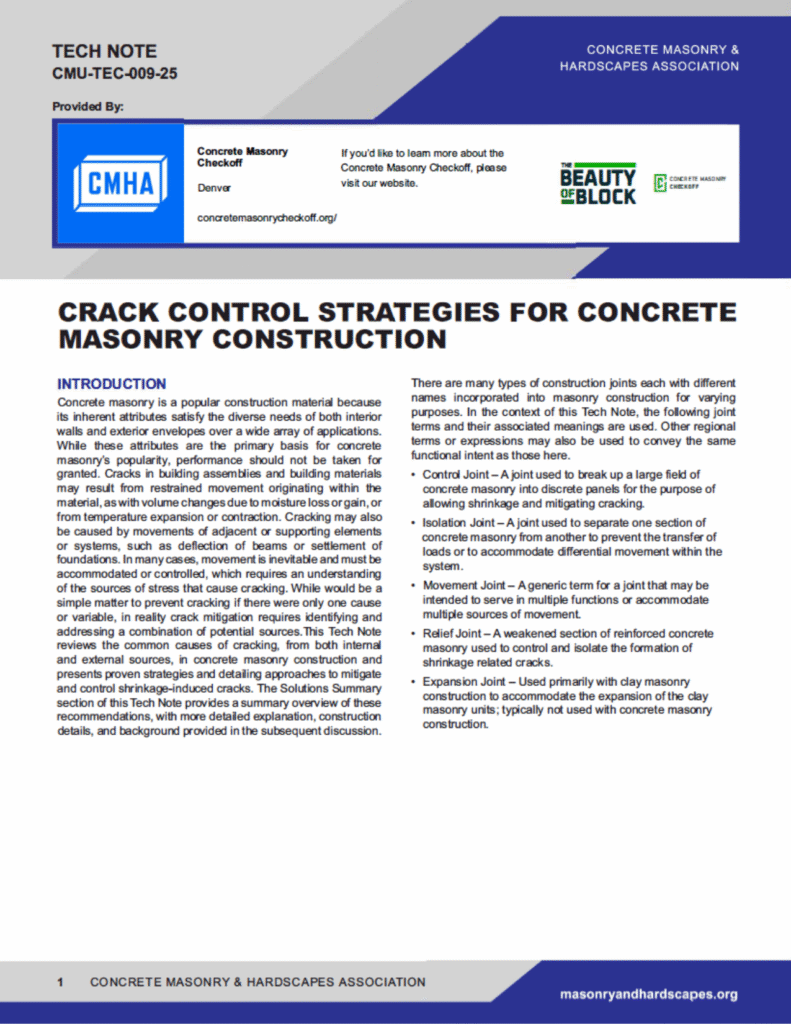
Concrete masonry is a popular construction material because its inherent attributes satisfy the diverse needs of both interior walls and exterior envelopes over a wide array of applications. While these attributes are the primary basis for concrete masonry’s popularity, performance should not be taken for granted. Cracks in building assemblies and building materials may result from restrained movement originating within the material, as with volume changes due to moisture loss or gain, or from temperature expansion or contraction. Cracking may also be caused by movements of adjacent or supporting elements or systems, such as deflection of beams or settlement of foundations. In many cases, movement is inevitable and must be accommodated or controlled, which requires an understanding of the sources of stress that cause cracking. While would be a simple matter to prevent cracking if there were only one cause or variable, in reality crack mitigation requires identifying and addressing a combination of potential sources.This Tech Note reviews the common causes of cracking, from both internal and external sources, in concrete masonry construction and presents proven strategies and detailing approaches to mitigate and control shrinkage-induced cracks. The Solutions Summary section of this Tech Note provides a summary overview of these recommendations, with more detailed explanation, construction details, and background provided in the subsequent discussion.
Properties and Characteristics in Concrete Masonry Construction
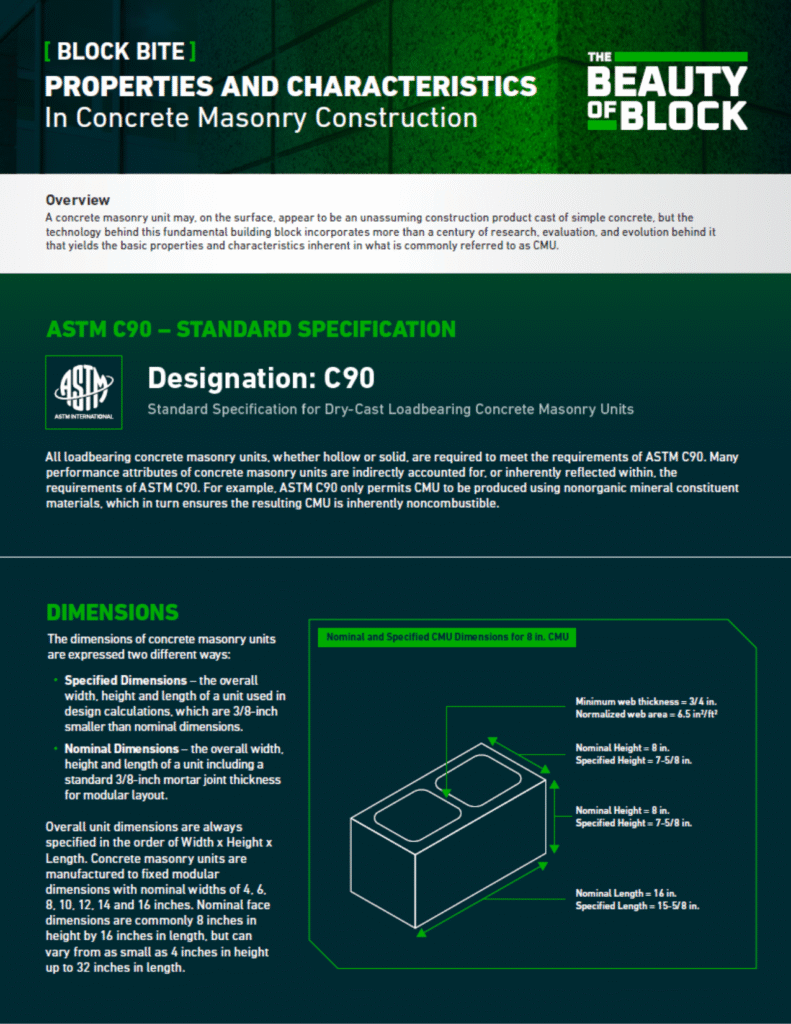
A concrete masonry unit may, on the surface, appear to be an unassuming construction product cast of simple concrete, but the technology behind this fundamental building block incorporates more than a century of research, evaluation, and evolution behind it that yields the basic properties and characteristics inherent in what is commonly referred to as CMU.
Design for Dry Single-Wythe Concrete Masonry Walls
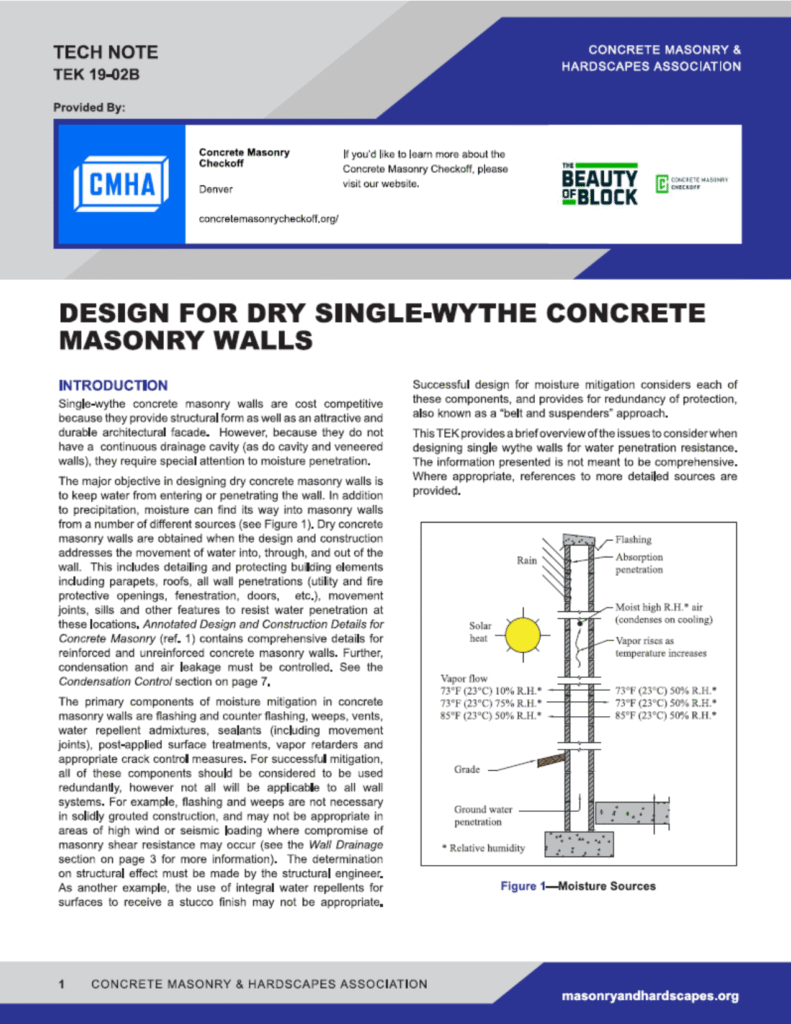
Single-wythe concrete masonry walls are cost competitive because they provide structural form as well as an attractive and durable architectural facade. However, because they do not have a continuous drainage cavity (as do cavity and veneered walls), they require special attention to moisture penetration.
Joint Sealants for Concrete Masonry Walls
Successfully sealing joints, such as control joints and around door jambs and window frames, in concrete masonry walls depends on the overall design and construction of the entire building envelope. Movement joints (also called control joints) are needed in some concrete masonry walls to accommodate drying shrinkage, thermal movements, and movements between different building components. Movement joints, joints around fenestration, doors and penetrations, and isolation joints (joints at dissimilar material interfaces) rely on joint sealants to help preserve the overall weather-tightness of the building envelope. In addition, properly sealed joints may be required to meet a specified fire resistance rating or sound transmission class.
Flashing Details for Concrete Masonry Walls

At critical locations throughout a building, moisture that manages to penetrate a wall is collected and diverted to the outside by means of flashing. The type of flashing and its installation may vary depending upon exposure conditions, opening types, locations and wall types. This TEK includes typical flashing details that have proven effective over a wide geographical range. The reader is also encouraged to review the companion TEK 19-04A Flashing Strategies for Concrete Masonry Walls (ref. 1) which addresses the effect of moisture on masonry, design considerations, flashing materials, construction practices, and maintenance of flashing.
Flashing Strategies for Concrete Masonry Walls
The primary role of flashing is to intercept the flow of moisture through masonry and direct it to the exterior of the structure. Due to the abundant sources of moisture and the potentially detrimental effects it can have, the choice of flashing material, and the design and construction of flashing details, can often be as key to the performance of a masonry structure as that of the structural system.
