
Maximizing Partition Wall Efficiency with 6 Inch CMU
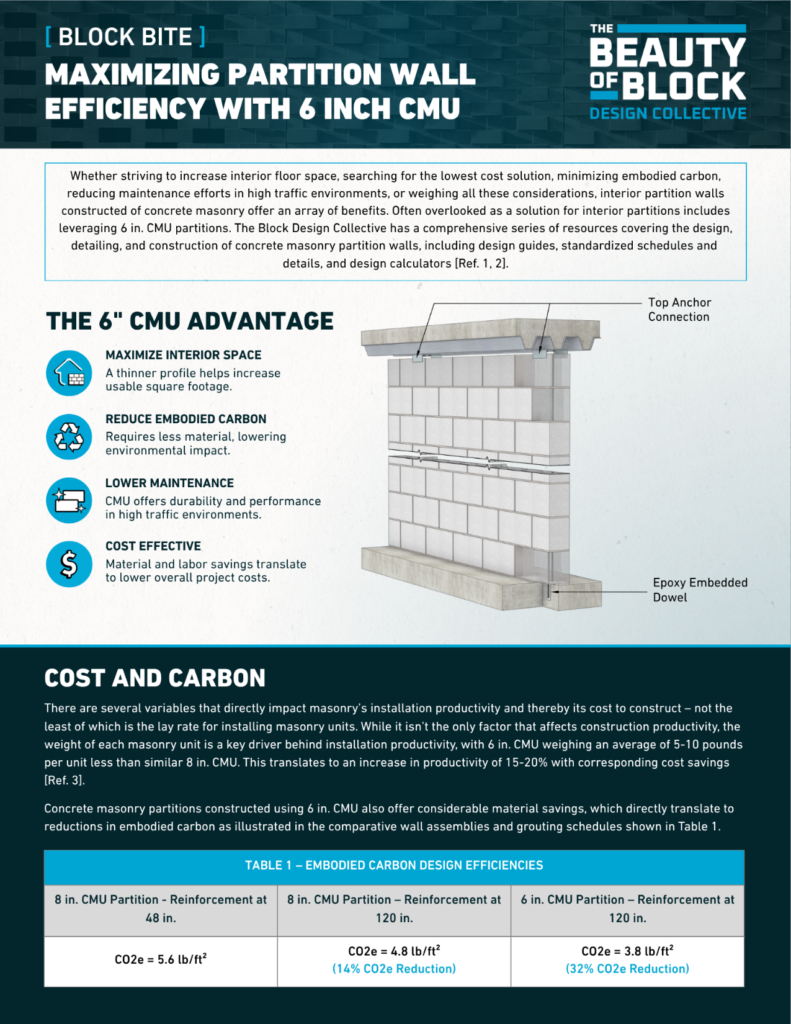
Whether striving to increase interior floor space, searching for the lowest cost solution, minimizing embodied carbon, reducing maintenance efforts in high traffic environments, or weighing all these considerations, interior partition walls constructed of concrete masonry offer an array of benefits. Often overlooked as a solution for interior partitions includes leveraging 6 in. CMU partitions. The Block Design Collective has a comprehensive series of resources covering the design, detailing, and construction of concrete masonry partition walls, including design guides, standardized schedules and
details, and design calculators [Ref. 1, 2].
Design and Detailing Guide for Nonloadbearing Concrete Masonry Partition Walls
This guide provides a comprehensive resource for the design and detailing of interior nonloadbearing concrete masonry partition walls, outlining key considerations that influence performance, constructability, and efficiency. It brings together best practices related to fire resistance, sound control, structural behavior, crack control, and connection detailing, while also emphasizing strategies that improve cost-effectiveness and reduce material use. Through a combination of explanatory content and pre-engineered solutions, the guide is intended to support designers in making informed decisions and efficiently incorporating concrete masonry partitions into project documents.
Architectural CMU Basics

Most people know what a concrete block is, but beyond the standard units used in basements or concealed structural applications, architectural concrete masonry units (CMU) are made to be seen and celebrated. Architectural block provides a diverse selection of bond patterns, colors and finishes — delivering versatility that supports performance requirements and design intent. This block bite reviews the array of aesthetic possibilities available when using architectural concrete masonry.
Design for Dry Single-Wythe Concrete Masonry Walls
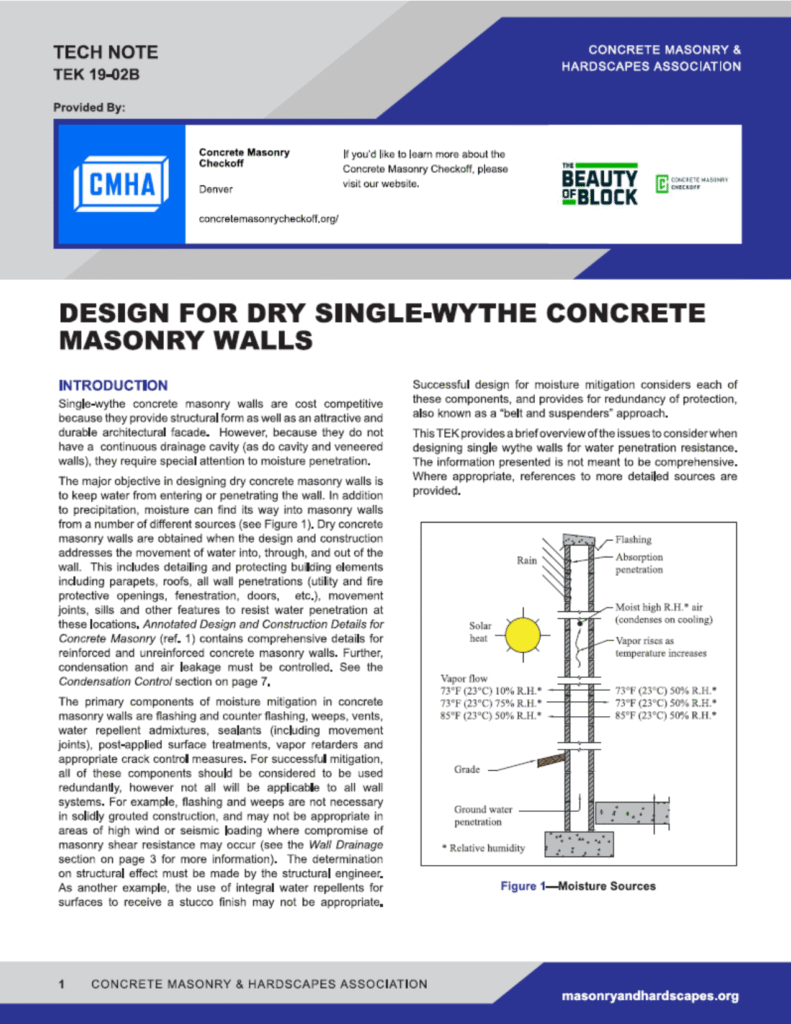
Single-wythe concrete masonry walls are cost competitive because they provide structural form as well as an attractive and durable architectural facade. However, because they do not have a continuous drainage cavity (as do cavity and veneered walls), they require special attention to moisture penetration.
Joint Sealants for Concrete Masonry Walls
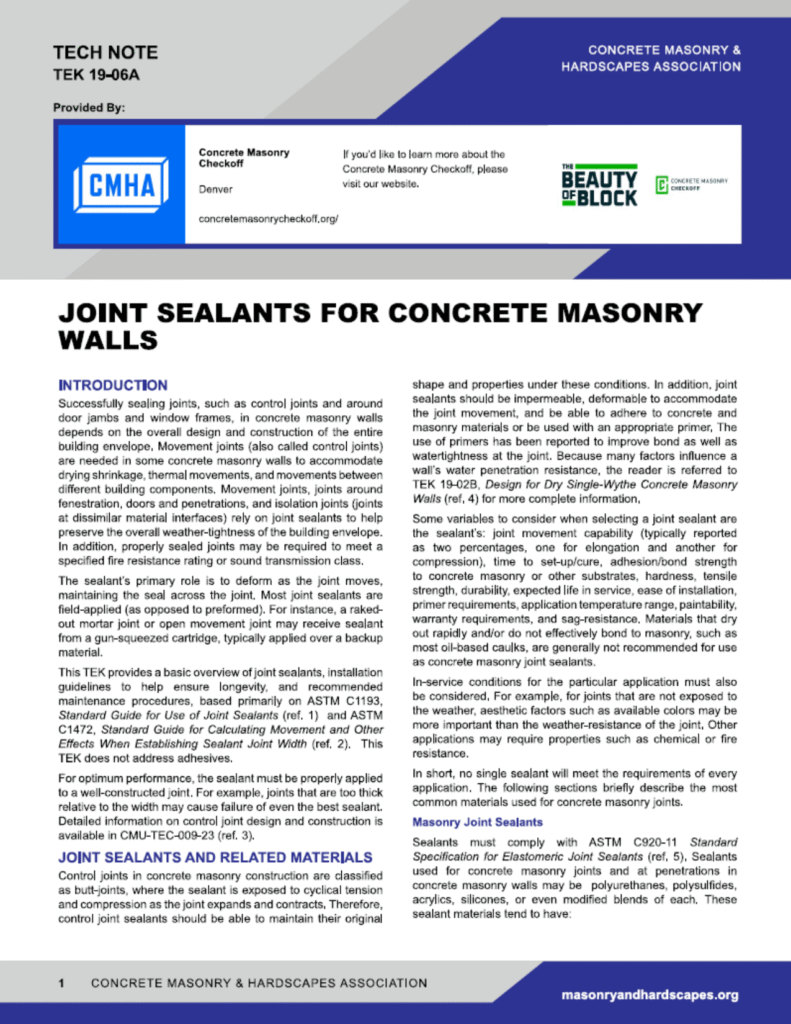
Successfully sealing joints, such as control joints and around door jambs and window frames, in concrete masonry walls depends on the overall design and construction of the entire building envelope. Movement joints (also called control joints) are needed in some concrete masonry walls to accommodate drying shrinkage, thermal movements, and movements between different building components. Movement joints, joints around fenestration, doors and penetrations, and isolation joints (joints at dissimilar material interfaces) rely on joint sealants to help preserve the overall weather-tightness of the building envelope. In addition, properly sealed joints may be required to meet a specified fire resistance rating or sound transmission class.
Flashing Details for Concrete Masonry Walls

At critical locations throughout a building, moisture that manages to penetrate a wall is collected and diverted to the outside by means of flashing. The type of flashing and its installation may vary depending upon exposure conditions, opening types, locations and wall types. This TEK includes typical flashing details that have proven effective over a wide geographical range. The reader is also encouraged to review the companion TEK 19-04A Flashing Strategies for Concrete Masonry Walls (ref. 1) which addresses the effect of moisture on masonry, design considerations, flashing materials, construction practices, and maintenance of flashing.
Flashing Strategies for Concrete Masonry Walls
The primary role of flashing is to intercept the flow of moisture through masonry and direct it to the exterior of the structure. Due to the abundant sources of moisture and the potentially detrimental effects it can have, the choice of flashing material, and the design and construction of flashing details, can often be as key to the performance of a masonry structure as that of the structural system.
