
Architectural Concrete Masonry: Single-Wythe Walls
This course introduces the design and performance fundamentals of architectural single-wythe concrete masonry. Participants will explore how concrete masonry’s inherent durability, resilience, thermal mass, and low-embodied-carbon contribute to high-performing building envelopes. The program explains key strategies for moisture management—including surface protection, integral water repellents, flashing, weeps, and crack-control detailing to keep single-wythe CMU walls dry and long-lasting. Learners will examine energy-code compliance pathways for mass walls, insulation options, and how density, thermal mass, and assembly configuration influence energy performance. The course concludes with practical guidance on air and vapor barriers, utilities, sample panels, and cleaning procedures to ensure high-quality outcomes in architectural CMU projects.
Architectural Concrete Masonry: Veneers & Cavity Walls

Architectural concrete masonry anchored veneers combine beauty, durability, and low maintenance while offering architects significant design flexibility. This course examines the finishes, sizes, profiles, and colors that distinguish architectural CMU, and explores the high performance these systems achieve when coupled with concrete masonry cavity walls. Participants will review essential detailing recommendations for veneers, including how to accommodate openings, flashing, anchoring, and crack control strategies. The session also covers energy performance benefits, thermal mass advantages, and cavity wall insulation strategies, while emphasizing quality assurance through sample panels. The course finishes with discussing cleaning recommendations for architectural masonry.
Climate-Responsive Design: Balancing Resilience, Thermal Performance and Embodied Carbon with Concrete Masonry
This course explores how using concrete masonry units (CMU) in the built environment provides an integrated approach to climate-responsive design by simultaneously addressing three critical sustainability strategies: resilience, operational energy use, and embodied carbon reduction. Participants will examine how CMU construction offers inherent solutions to modern building challenges, from natural disasters and extreme weather events to energy conservation and carbon footprint reduction. The course demonstrates that CMU structures perform beyond code requirements without additional measures, providing durable, cost-effective buildings that support community resilience while contributing to low embodied carbon goals.
Concrete Masonry: Navigating Energy Codes to Maximize Thermal Mass Performance
This course examines how concrete masonry’s thermal mass contributes to energy efficiency across a range of climate zones and building types. It describes the role of heat capacity and mass wall behavior in overall thermal performance and outlines how these attributes are addressed within current energy codes. The session reviews prescriptive, trade-off, and whole-building performance pathways in ASHRAE 90.1 and the IECC, highlighting how CMU assemblies are evaluated in each method. The course also presents commonly used compliance tools, and shows how they support energy-code documentation for mass-wall designs.
Thermal Performance of Concrete Masonry Construction
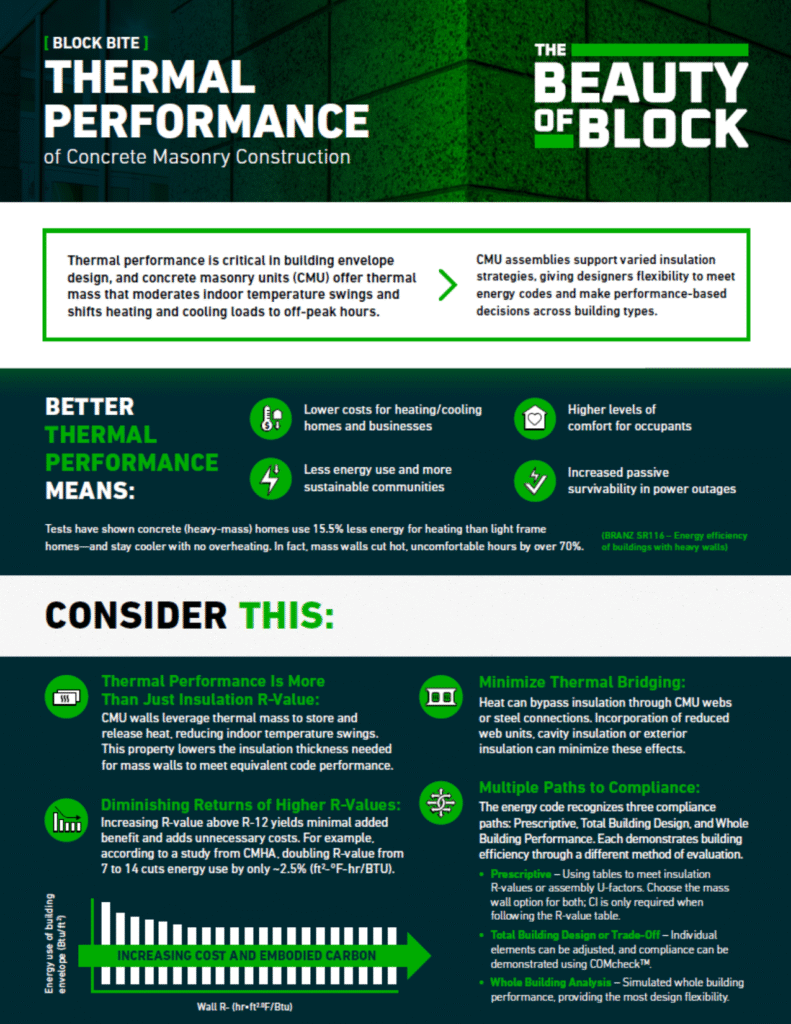
Thermal performance is critical in building envelope design, and concrete masonry units (CMU) offer thermal mass that moderates indoor temperature swings and shifts heating and cooling loads to off-peak hours. CMU assemblies support varied insulation strategies, giving designers flexibility to meet energy codes and make performance-based decisions across building types.
Thermal Catalog of Concrete Masonry Assemblies, 2nd Edition
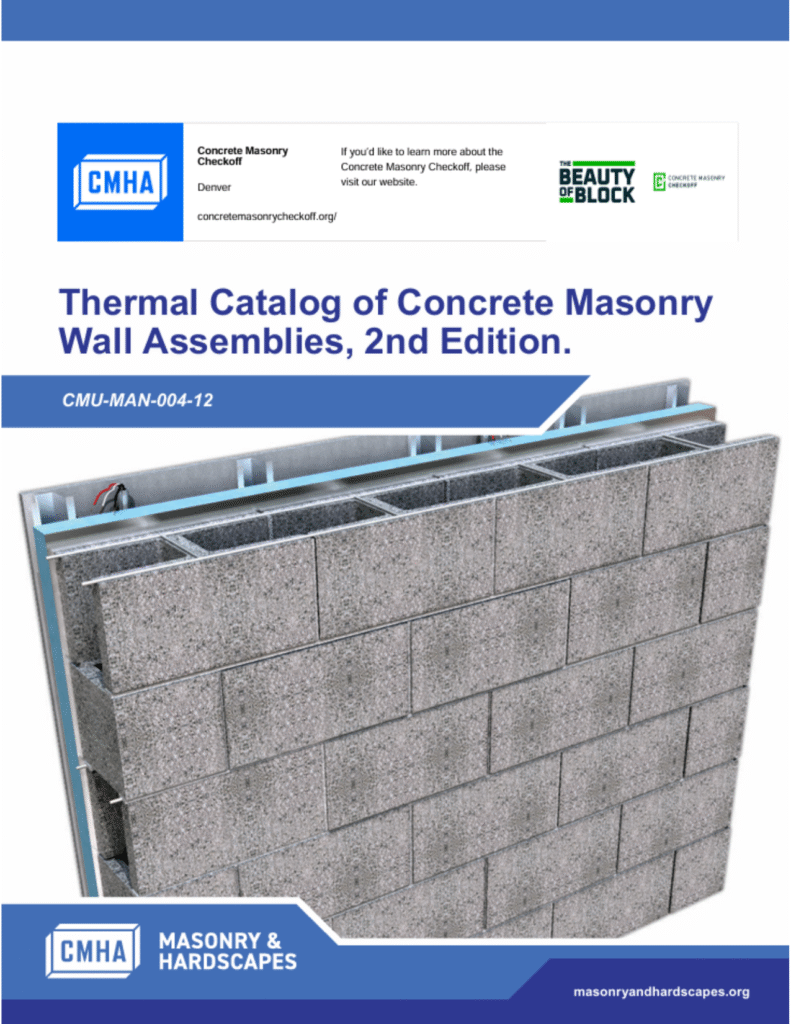
Energy codes continue to evolve and requirements for building envelopes continue to tighten. Fortunately, concrete masonry construction provides a wide variety of options to meet the energy needs of nearly every project. This catalog of assemblies provides code-supported R-values and U-factors for thousands of concrete masonry assemblies. Single-wythe, multi-wythe, various insulation locations, and additional finish systems are all included. Assemblies from R-3 to R-30 and more can be found in this guide.
Core Performance: The 5 Ss of Concrete Masonry
Concrete masonry is commonly used for structural and architectural walls in buildings. Knowing the full extent of its applications and capabilities is important for designers to make resilient, sustainable, and cost-effective buildings.
The intent of this course is to provide a general overview of the properties and performance characteristics of concrete masonry walls. Attendees will learn about how to take advantage of and maximize the features and capabilities of concrete masonry units.
Heat Capacity (HC) Values for Concrete Masonry Walls
Heat capacity is a material property used to assess a wall’s thermal mass, and it is often used as a criteria in energy codes and standards. Thermal mass is defined as: the absorption and storage of significant amounts of heat in a building or in walls of a building (ref. 1). Wall thermal mass, such as that present in concrete masonry construction, tends to decrease both heating and cooling loads in a given building, thus saving energy. The amount of savings realized by incorporating thermal mass into a building’s design is a function of several variables. These include local climate, wall heat capacity, fenestration (window) area, fenestration orientation, fenestration solar gain, building occupancy load and other internal gains such as lights and office equipment. The most manageable approach to account for energy savings due to thermal mass is to relate the savings to the wall heat capacity and local climate.
Thermal Bridges in Wall Construction
Thermal bridging occurs when a relatively small area of a wall, floor or roof loses much more heat than the surrounding area. Thermal bridging can occur in any type of building construction. The effects of thermal bridging may include increased heat loss, occupant discomfort, unanticipated expansion/contraction, condensation, freeze-thaw damage, and related moisture and/or mold problems for materials susceptible to moisture. The severity of the thermal bridge is determined by the extent of these effects.
Concrete Masonry in the 2012 Edition of the IECC
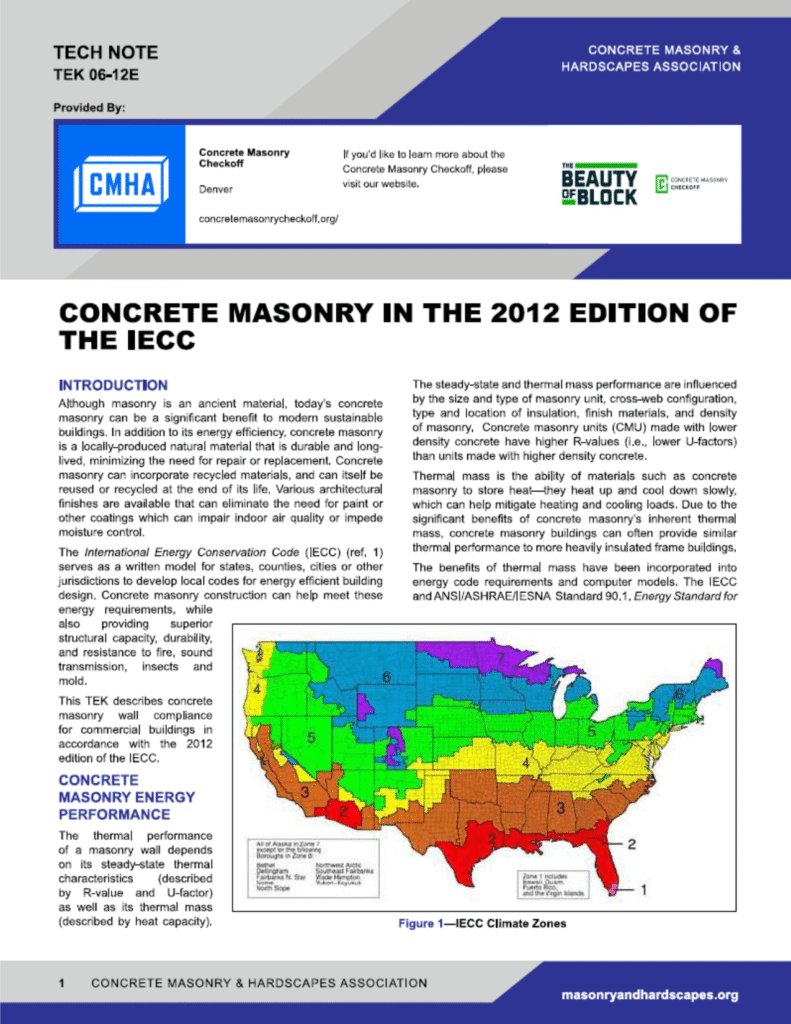
Although masonry is an ancient material, today’s concrete masonry can be a significant benefit to modern sustainable buildings. In addition to its energy efficiency, concrete masonry is a locally produced natural material that is durable and long lived, minimizing the need for repair or replacement. Concrete masonry can incorporate recycled materials, and can itself be reused or recycled at the end of its life. Various architectural finishes are available that can eliminate the need for paint or other coatings which can impair indoor air quality or impede moisture control.
