Modern codes, materials and structural design software make concrete masonry more efficient than ever
In the business of building, efficiency drives savings — and CMU helps you capture both. As project demands grow more complex, CMU offers a cost-effective path to maximum efficiency while meeting modern code requirements.
Here’s how concrete masonry can help uncover meaningful savings on your next project.
LAYOUT EFFICIENCIES
Modularity
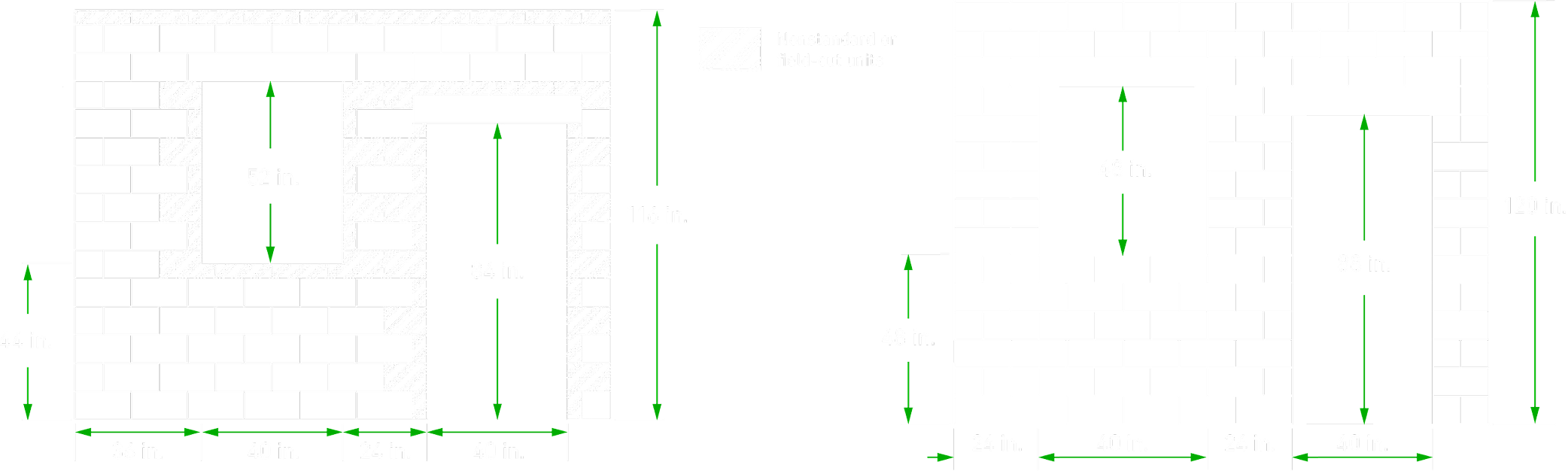
Concrete masonry can be detailed to almost any dimension, but projects are far more efficient when layouts follow modular coordination. Aligning wall lengths, heights, and openings to standard CMU increments reduces on-site ambiguity and avoids unnecessary cutting, waste and rework.
Modular planning also improves spatial efficiency and simplifies detailing. As the elevations illustrate, a modular wall can be larger than the non-modular alternative while using fewer units — savings that scale quickly across a project.
Wall Thickness
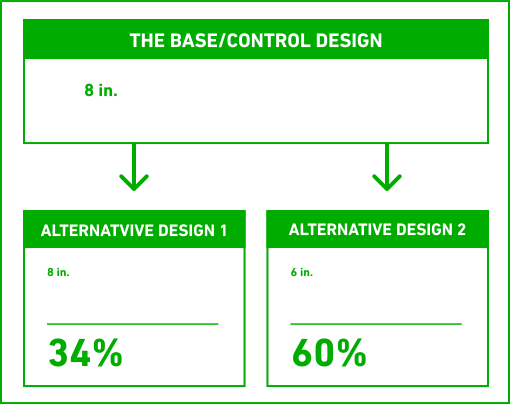
Advances in codes and engineering methods allow CMU wall thickness to be more closely matched to structural demand. Walls that once required 8 inch CMU can now often be designed with 6 inch, and assemblies traditionally using 12 inch units can frequently be designed at 10 inch or even 8 inch, depending on loads and conditions.
Optimizing wall thickness reduces material, grout, labor, and embodied carbon while supporting overall material efficiency.
The comparison shown here illustrates this approach. The left column represents a common default; the middle, a partially optimized approach; the right, the fully efficient solution — all meeting the same design criteria.
8 in. CMU Partition – Reinforcement at 48 in.
8 in. CMU Partition – Maximum Reinforcement Spacing
6 in. CMU Partition – Maximum Reinforcement Spacing
CO₂e = 785 LB
CO₂e = 518 lb (34% CO₂e Reduction)
CO₂e = 320 lb (60% CO₂e Reduction)
SOURCE: Mutual Materials
material EFFICIENCIES
Local Production
Selecting unit characteristics such as color, finish and density that align with local manufacturing capabilities can meaningfully reduce cost. When efficiency and budget are priorities, early coordination with regional CMU producers helps ensure the most appropriate and economical units are specified.
Less Grout, Less Steel Efficient design balances structural demands with material optimization. When those demands align with the intended CMU wall system, assemblies safely resist anticipated loads while remaining practical and economical. Industry-supported structural design software helps designers align CMU wall design with structural demand and code requirements.
NEED Project Support?
CONNECT WITH A BLOCK DESIGN PROFESSIONAL TODAY!
Complete our simple designassistance form or connect directly with the technical director in your area.
Bond beams should be used only when structurally necessary. Otherwise, joint reinforcement delivers the required performance at lower cost, with less grout and steel, and without slowing construction.
Distinction Between Concrete Masonry & Other Concrete Systems
Reinforced concrete masonry and reinforced concrete perform differently and are designed accordingly: masonry under TMS 402 and concrete under ACI 318. Treating masonry like concrete in detailing provides no structural benefit and can drive avoidable cost and complexity.
Use Appropriate Baseline Compressive Strength
Most CMU assemblies can be designed at 2,000 f’m. Higher strengths may be specified when required and confirmed with local producers. When not structurally necessary, increased compressive strength raises cement content, cost and embodied carbon without improving performance.
Unlike concrete, which is typically limited to 3,000 f’m or higher, CMU can adhere to actual design demand.
INEFFICIENT DESIGN ADDS UNNECESSARY COST
Maximize Reinforcement Spacing
In many low-seismic applications, vertical reinforcement in CMU walls can be spaced up to 120 inches on center while meeting performance requirements. For typical interior partitions, similar performance can often be achieved using 6-inch CMU instead of 8-inch units at the same spacing.
These approaches reduce material, labor, and embodied carbon without compromising structural performance.
Lintels
Specifying steel lintels is typically more expensive than masonry lintels and introduces ongoing maintenance. Steel also reduces fire resistance and must be clad to match adjacent masonry, adding cost and installation time. CMU bond beams with horizontal rebar can be used over most openings.
Stand-Alone Structure
Steel or concrete frames are often paired with masonry infill because the frame carries gravity loads while masonry provides lateral resistance. In many cases though, masonry can perform both roles. Designing CMU as the full structural system can eliminate separate framing, cutting material use and streamlining schedules.
DOING MORE WITH LESS.
That’s the Beauty of Block.
RESOURCES
Explore the resources below for more insights on how to incorporate concrete masonry to enhance the resilience of your designs.
We use cookies on our website to give you the most relevant experience by remembering your preferences and repeat visits. By clicking “Accept”, you consent to the use of ALL the cookies. However you may visit Cookie Settings to provide a controlled consent.