
Flashing Details for Concrete Masonry Walls

At critical locations throughout a building, moisture that manages to penetrate a wall is collected and diverted to the outside by means of flashing. The type of flashing and its installation may vary depending upon exposure conditions, opening types, locations and wall types. This TEK includes typical flashing details that have proven effective over a wide geographical range. The reader is also encouraged to review the companion TEK 19-04A Flashing Strategies for Concrete Masonry Walls (ref. 1) which addresses the effect of moisture on masonry, design considerations, flashing materials, construction practices, and maintenance of flashing.
Flashing Strategies for Concrete Masonry Walls
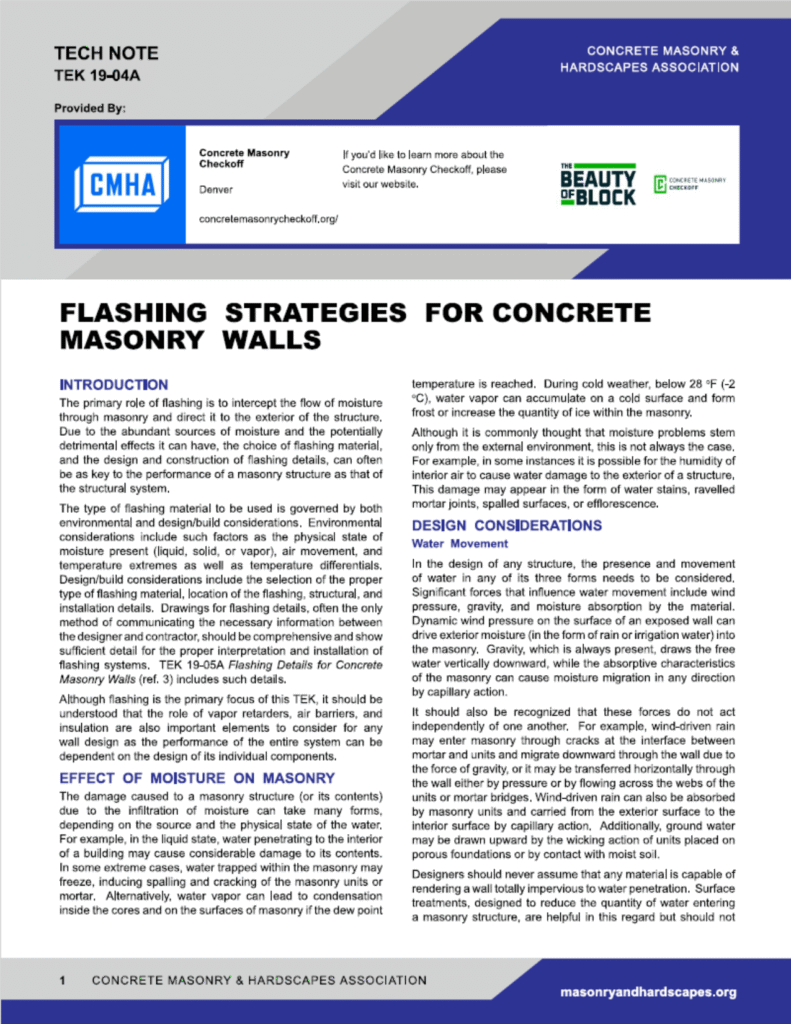
The primary role of flashing is to intercept the flow of moisture through masonry and direct it to the exterior of the structure. Due to the abundant sources of moisture and the potentially detrimental effects it can have, the choice of flashing material, and the design and construction of flashing details, can often be as key to the performance of a masonry structure as that of the structural system.
Smart Applications for Concrete Masonry Systems
“Smart Applications for Concrete Masonry Systems” explores how concrete masonry units (CMU) function structurally and reviews their diverse applications in construction. CMU’s intrinsic values including durability, energy efficiency through thermal mass, fire resistance, ballistic protection, sound attenuation, and storm resilience are covered. It examines various applications from cavity walls and single-wythe structures to fire walls, stairwells, corridors, and public spaces, emphasizing how concrete masonry provides both functional benefits and aesthetic possibilities while offering superior performance.
Major Changes in Masonry Structural Standards: TMS 402/602-22
The masonry design standards, TMS 402/602 Building Code Requirements and Specification for Masonry Structures were updated in 2022 following a 6-year revision cycle. This course covers the major changes in these standards which include a complete rewriting of the veneer provisions, the introduction of compression-controlled sections in strength design, anchor bolt recalibration to be based on the ultimate strength of steel, and the addition of an appendix on masonry reinforced with GFRP (Glass Fiber Reinforced Polymer) bars. These changes and many more will be discussed, and the impact of the changes on typical designs will be reviewed.
Key Properties Related to ASTM C90 & Concrete Masonry
This course provides a comprehensive overview of concrete masonry units (CMU), focusing on the following key topics: defining what CMU is, typical concrete masonry wall assemblies, exploring ASTM C90 standard specification requirements and density-related performance properties, and reviewing moisture penetration resistance strategies. These strategies include flashing and weeps, integral water repellent, and crack control.