
Architectural Concrete Masonry: Single-Wythe Walls
This course introduces the design and performance fundamentals of architectural single-wythe concrete masonry. Participants will explore how concrete masonry’s inherent durability, resilience, thermal mass, and low-embodied-carbon contribute to high-performing building envelopes. The program explains key strategies for moisture management—including surface protection, integral water repellents, flashing, weeps, and crack-control detailing to keep single-wythe CMU walls dry and long-lasting. Learners will examine energy-code compliance pathways for mass walls, insulation options, and how density, thermal mass, and assembly configuration influence energy performance. The course concludes with practical guidance on air and vapor barriers, utilities, sample panels, and cleaning procedures to ensure high-quality outcomes in architectural CMU projects.
Moisture Control for Concrete Masonry Wall Construction
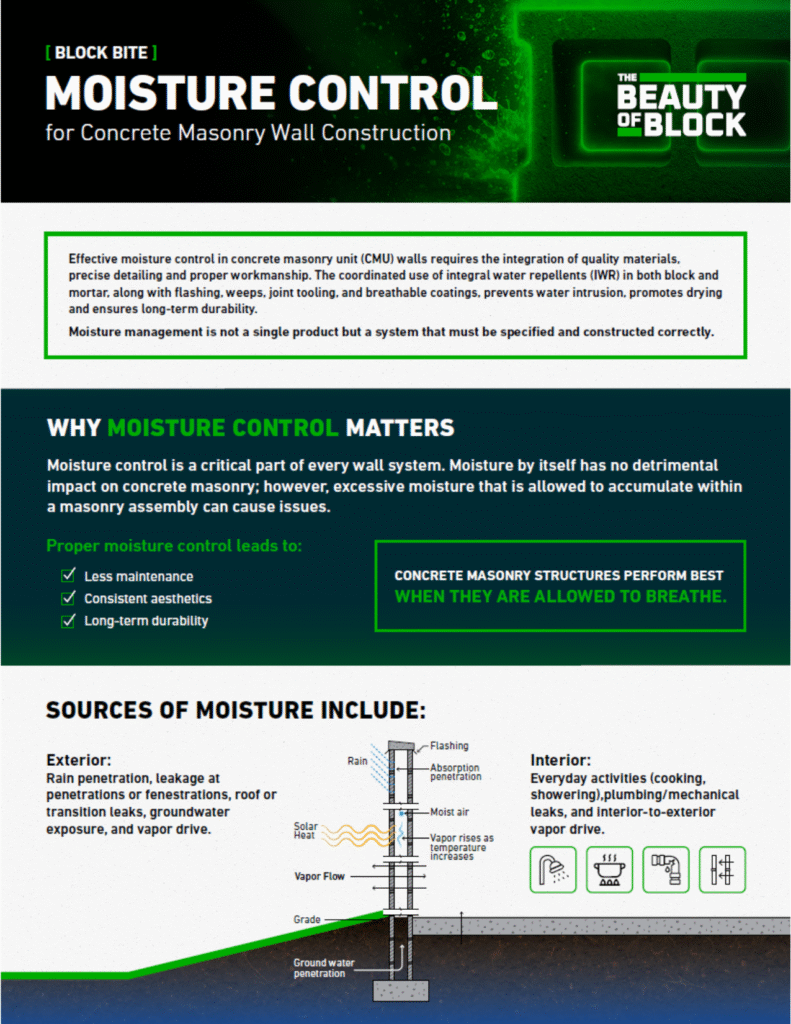
Effective moisture control in concrete masonry unit (CMU) walls requires the integration of quality materials, precise detailing and proper workmanship. The coordinated use of integral water repellents (IWR) in both block and mortar, along with flashing, weeps, joint tooling, and breathable coatings, prevents water intrusion, promotes drying and ensures long-term durability.
Moisture management is not a single product but a system that must be specified and constructed correctly.
Design for Dry Single-Wythe Concrete Masonry Walls
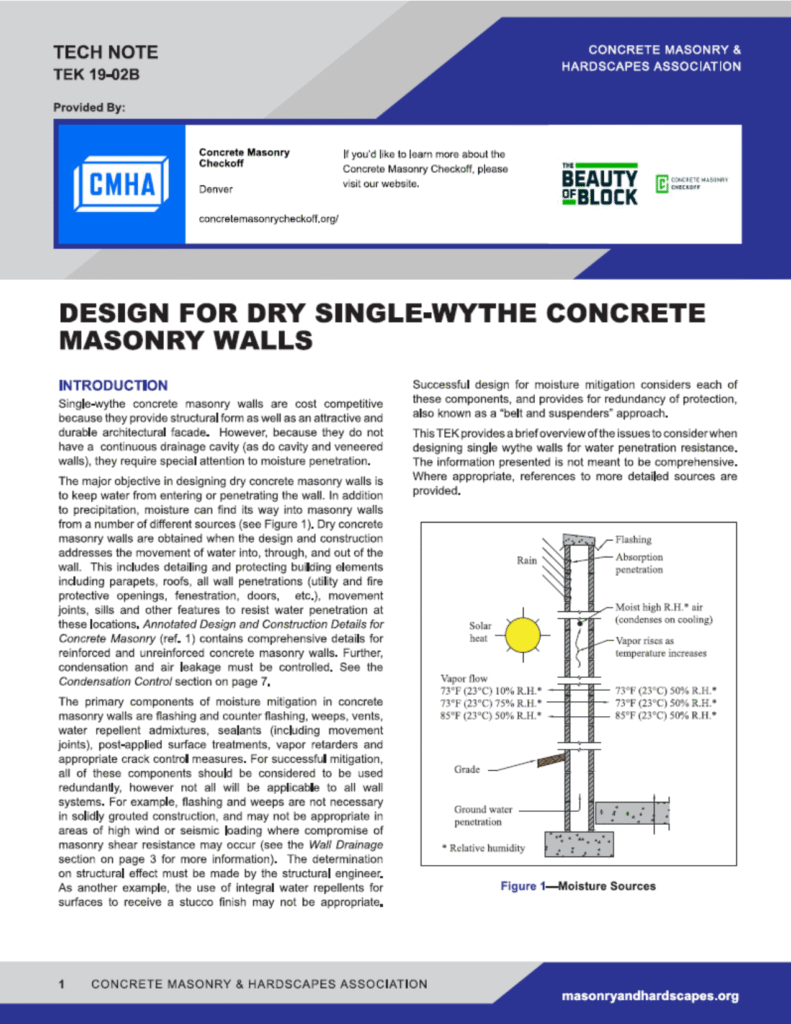
Single-wythe concrete masonry walls are cost competitive because they provide structural form as well as an attractive and durable architectural facade. However, because they do not have a continuous drainage cavity (as do cavity and veneered walls), they require special attention to moisture penetration.
Joint Sealants for Concrete Masonry Walls
Successfully sealing joints, such as control joints and around door jambs and window frames, in concrete masonry walls depends on the overall design and construction of the entire building envelope. Movement joints (also called control joints) are needed in some concrete masonry walls to accommodate drying shrinkage, thermal movements, and movements between different building components. Movement joints, joints around fenestration, doors and penetrations, and isolation joints (joints at dissimilar material interfaces) rely on joint sealants to help preserve the overall weather-tightness of the building envelope. In addition, properly sealed joints may be required to meet a specified fire resistance rating or sound transmission class.
Flashing Details for Concrete Masonry Walls

At critical locations throughout a building, moisture that manages to penetrate a wall is collected and diverted to the outside by means of flashing. The type of flashing and its installation may vary depending upon exposure conditions, opening types, locations and wall types. This TEK includes typical flashing details that have proven effective over a wide geographical range. The reader is also encouraged to review the companion TEK 19-04A Flashing Strategies for Concrete Masonry Walls (ref. 1) which addresses the effect of moisture on masonry, design considerations, flashing materials, construction practices, and maintenance of flashing.
Flashing Strategies for Concrete Masonry Walls
The primary role of flashing is to intercept the flow of moisture through masonry and direct it to the exterior of the structure. Due to the abundant sources of moisture and the potentially detrimental effects it can have, the choice of flashing material, and the design and construction of flashing details, can often be as key to the performance of a masonry structure as that of the structural system.
Preventing Water Penetration in Below-Grade Concrete Masonry Walls

Concrete masonry has traditionally been the material of choice for foundation wall construction. State-of-the-art waterproofing, dampproofing, and drainage systems applied to concrete masonry provide excellent protection from water penetration, ensuring protection for building contents and comfort for occupants.
Condensation Control in Concrete Masonry Walls
Condensation is one type of moisture to which buildings can potentially be exposed. In addition to above grade precipitates of rain, snow and ice as well as high humidity, several forms of below-grade ground-sourced moisture can also affect building envelopes. Concrete masonry walls are less affected by the problems associated with moisture infiltration and condensate than other building materials (i.e. corrosion, rotting, mold, delamination, blistering and volumetric changes). However, prolonged moisture accumulation can lead to reduced effectiveness of some types of thermal insulation, temporary frost formation and/or efflorescence. Fortunately, these problems can largely be avoided with proper wall design and construction.
Characteristics of Concrete Masonry Units with Integral Water Repellent
A concrete masonry unit’s characteristics are a function of the properties and proportions of the materials used, as well as the manufacturing processes. The unit characteristics do not singularly define the characteristics and performance attributes of a concrete masonry wall, but they certainly play a significant role in influencing those attributes. When used as part of a breathable exterior wall for an inhabited structure, or as a barrier for any conditioned or protected space, concrete masonry is expected to contribute to the water penetration resistance and moisture control of the wall assembly. Current model building codes include provisions intended to ensure that exterior walls provide adequate weather protection for the building (ref. 1).
Water Repellents for Concrete Masonry Walls
Water repellents are used on exterior walls to provide resistance to wind-driven rain. In addition, water repellents can also reduce the potential for efflorescence and staining from environmental pollutants, and enhance the color or texture of a wall.
