
Maximizing Partition Wall Efficiency with 6 Inch CMU
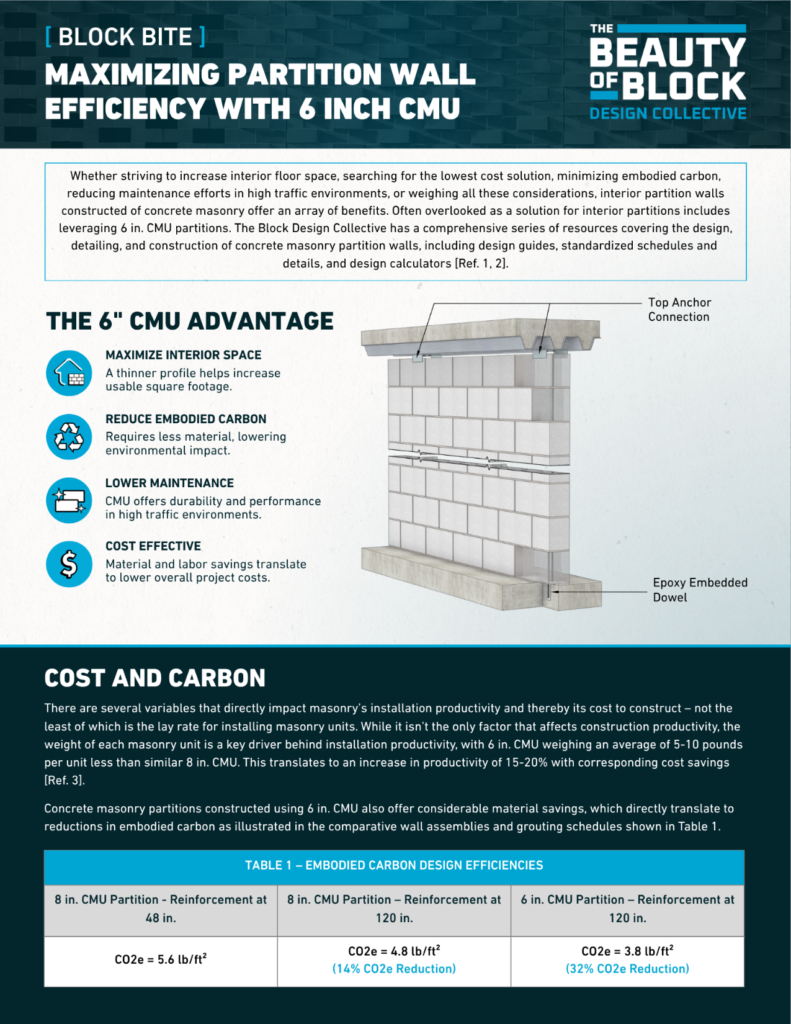
Whether striving to increase interior floor space, searching for the lowest cost solution, minimizing embodied carbon, reducing maintenance efforts in high traffic environments, or weighing all these considerations, interior partition walls constructed of concrete masonry offer an array of benefits. Often overlooked as a solution for interior partitions includes leveraging 6 in. CMU partitions. The Block Design Collective has a comprehensive series of resources covering the design, detailing, and construction of concrete masonry partition walls, including design guides, standardized schedules and
details, and design calculators [Ref. 1, 2].
Built for Learning: Concrete Masonry and Resilient K-12 Schools
This course will provide architects, engineers, and interior designers with the necessary tools to design more resilient K-12 buildings that foster healthier learning environments and safer spaces utilizing concrete masonry. Attendees will learn about structural, acoustic, and fire-resistant properties of CMU while exploring how it impacts first cost, life-cycle costs, and multiple building products and systems. Explore ways masonry will contribute to your sustainability goals through topics like resilience, embodied carbon, and carbon sequestration.
Broader Sustainability of CMU: Sourcing, Manufacturing and Circular Economy
This course uses resiliency, energy efficiency, and low embodied carbon as a brief jumping-off point to frame a broader discussion of sustainability considerations in concrete masonry design. Participants will explore life-cycle environmental impacts beyond embodied carbon and review CMU manufacturing process choices that can reduce overall impacts. The course also addresses CMU sourcing, extraction, and supply-chain considerations, including how availability, transportation, and procurement pathways can affect project outcomes. Finally, it introduces assembly efficiency and circularity strategies that reduce resource extraction and jobsite waste while enabling higher-value reuse at end of life.
Climate-Responsive Design: Balancing Resilience, Thermal Performance and Embodied Carbon with Concrete Masonry
This course explores how using concrete masonry units (CMU) in the built environment provides an integrated approach to climate-responsive design by simultaneously addressing three critical sustainability strategies: resilience, operational energy use, and embodied carbon reduction. Participants will examine how CMU construction offers inherent solutions to modern building challenges, from natural disasters and extreme weather events to energy conservation and carbon footprint reduction. The course demonstrates that CMU structures perform beyond code requirements without additional measures, providing durable, cost-effective buildings that support community resilience while contributing to low embodied carbon goals.
Concrete Masonry: From Manufacturing to Structural Applications
This module explores the fundamentals of concrete masonry construction, beginning with the manufacturing process of concrete masonry units (CMUs) and examining both standard gray block and architectural finishes.
Participants will learn about various CMU shapes, sizes, and modular design principles that optimize construction efficiency. The course covers essential structural considerations, including the differences between unit compressive strength and specified masonry assembly strength (f’m), and examines how tall structures can be built using concrete masonry.
Additionally, the module introduces efficient design strategies that help reduce both project costs and embodied carbon, making concrete masonry an economical and sustainable building solution.
Thermal Performance of Concrete Masonry Construction
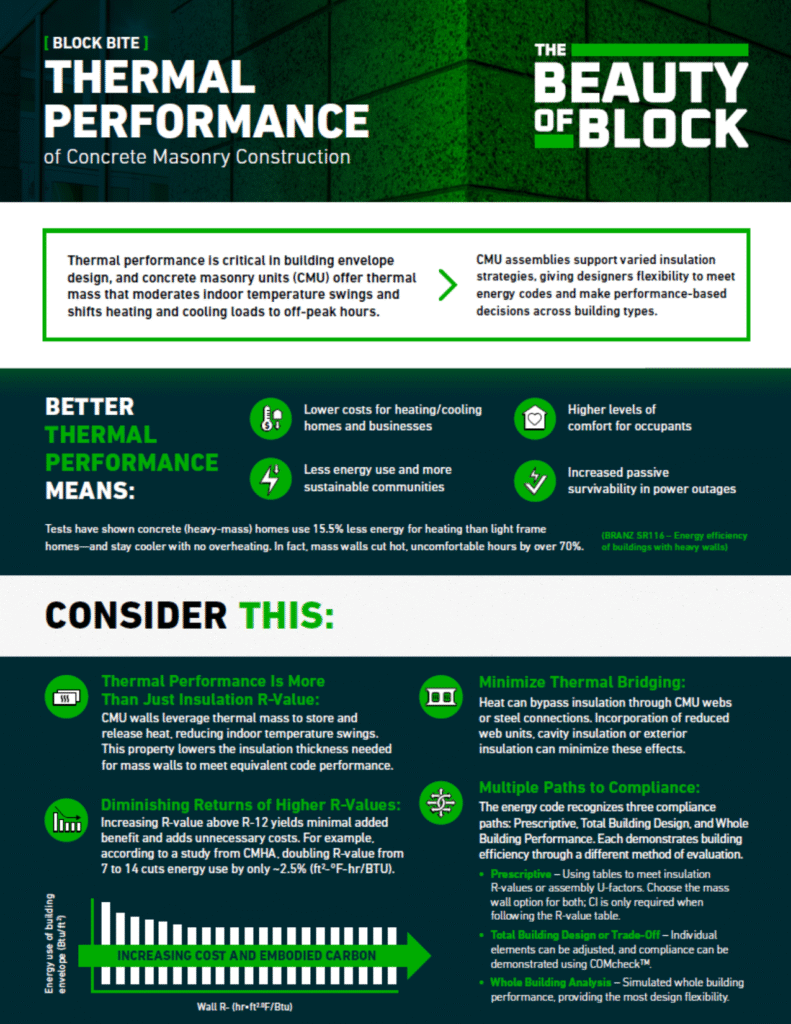
Thermal performance is critical in building envelope design, and concrete masonry units (CMU) offer thermal mass that moderates indoor temperature swings and shifts heating and cooling loads to off-peak hours. CMU assemblies support varied insulation strategies, giving designers flexibility to meet energy codes and make performance-based decisions across building types.
Thermal Catalog of Concrete Masonry Assemblies, 2nd Edition
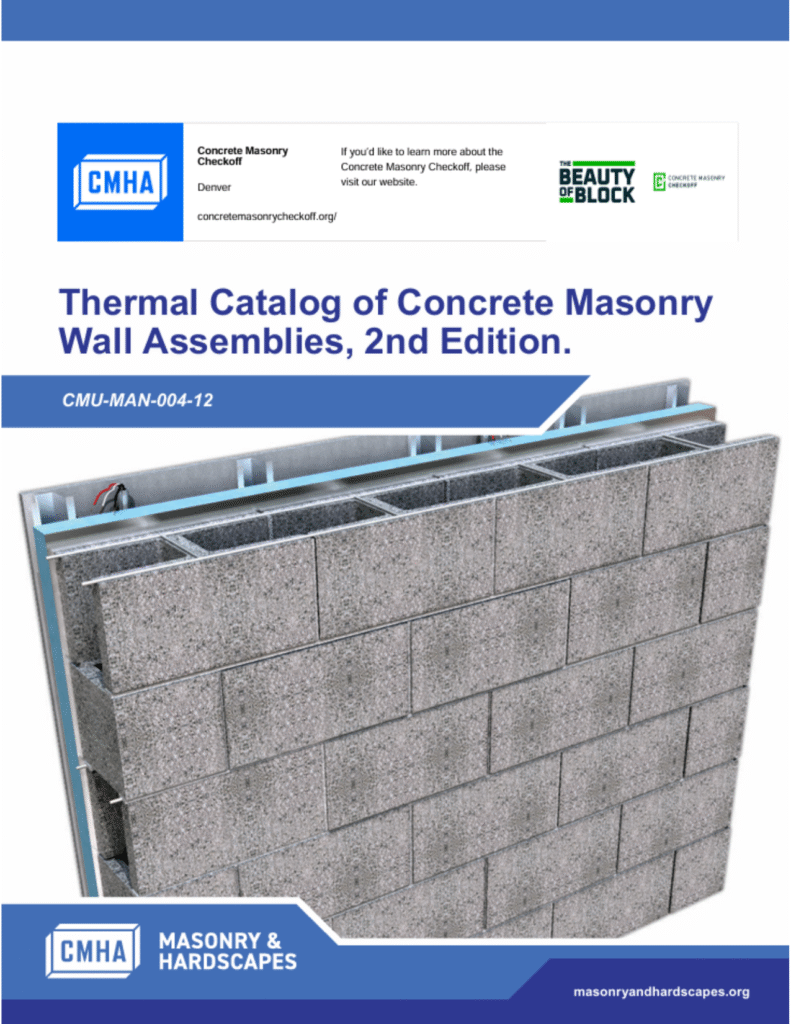
Energy codes continue to evolve and requirements for building envelopes continue to tighten. Fortunately, concrete masonry construction provides a wide variety of options to meet the energy needs of nearly every project. This catalog of assemblies provides code-supported R-values and U-factors for thousands of concrete masonry assemblies. Single-wythe, multi-wythe, various insulation locations, and additional finish systems are all included. Assemblies from R-3 to R-30 and more can be found in this guide.
Concrete Masonry: Inherent Resilience
Concrete masonry construction is resilient on its own, without the need for special provisions or extra fortifying costs, and it doesn’t need to be rebuilt after most natural or human-made disasters. Concrete masonry is inherently resilient beyond code requirements. By considering lifecycle costs rather than just initial construction expenses, concrete masonry offers significant advantages, including buildings that can withstand extreme events, reduce recovery costs, and maintain community continuity—qualities that are becoming increasingly important as disasters occur more frequently across all regions of the country.
CMU Embodied Carbon: Understanding Impacts Through LCA
This presentation provides an overview of why CMU assemblies are a low embodied carbon building material. It quantifies concrete masonry’s cradle-to-gate embodied carbon advantages by progressing from simple “mini LCA” wall assembly comparisons to prototype building LCA case studies. The course emphasizes how efficient design strategies, including modular coordination, optimized structure and strategic grout and reinforcement placement, serve as major drivers for both carbon reduction and cost savings. By exploring the intersection of design efficiency with sustainability goals, participants will learn how thoughtful CMU design decisions lower embodied carbon, reduce material usage, and improve project economics simultaneously.
CMU Embodied Carbon: Not All Concrete is the Same
This is the first course in our CMU embodied carbon series, focusing on how concrete masonry units (CMU) differ from traditional wet-cast concrete in terms of carbon impact. We will set the stage for the concrete and carbon sequestration discussion by looking at the larger geologic carbon cycle and greenhouse gas emissions; and how it all relates to climate change. We will then look at the concrete carbon cycle and recent CMHA sequestration research and testing which demonstrates the accelerated sequestration rates substantially reducing the overall embodied carbon of dry-cast CMU construction.
