
Concrete Masonry Lintel Design Manual
This guide provides an overview of the design and construction of reinforced concrete masonry lintels used to span openings in masonry walls. Lintels, sometimes referred to as beams, are structural members designed to support the wall above openings along with any additional imposed loads. The manual focuses on reinforced concrete masonry lintels and explains the two design approaches permitted by TMS 402/602: allowable stress design and strength design. It also covers commonly used materials, design loads, load distribution theory, code requirements, practical design examples, and pre-engineered design tables for common construction conditions. Reference formulas for shear, moment, and deflection are included to support the analysis and design process.
Screen Wall Calculator
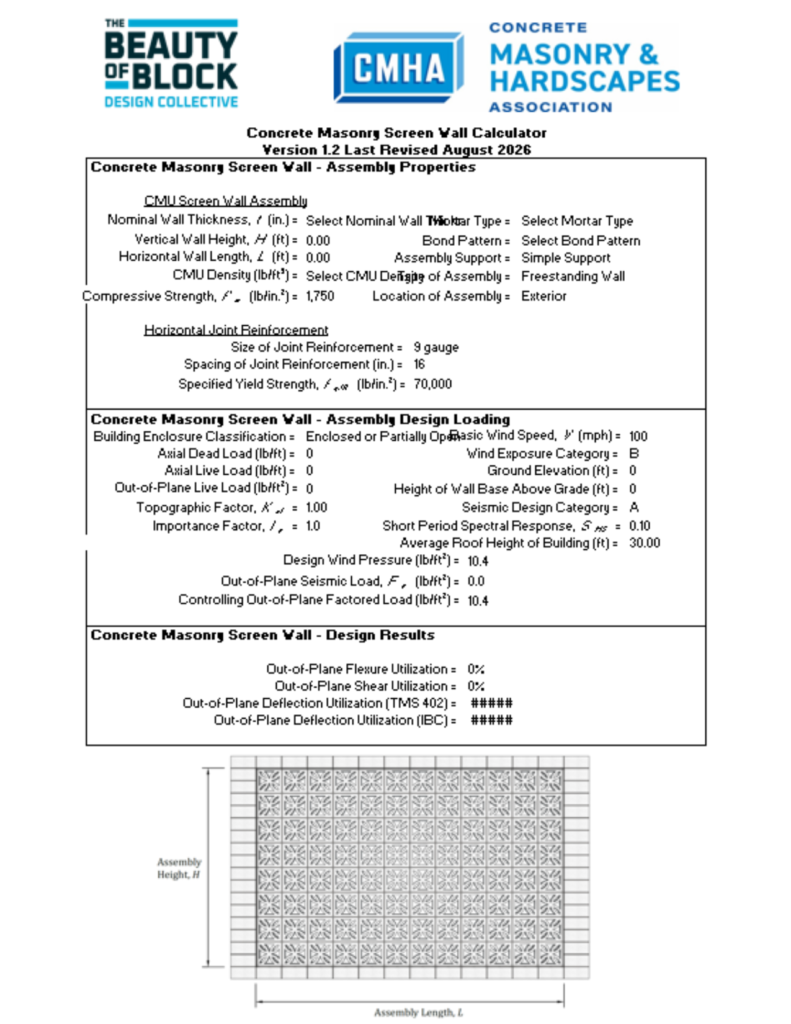
This calculator designs concrete masonry screen walls in accordance with the strength design provisions of TMS 402/602-22 and the loading criteria of ASCE/SEI 7-22 Chapter 28 for interior screen wall assemblies, ASCE/SEI 7 Chapter 29 for exterior screen wall assemblies, and Chapter 13 for seismic loading. Loading criteria is based on a uniform loading over wall surface with resultant at mid-height and mid-length of the assembly. Highlighted cells are user inputs. Inputs and outputs use inch-pound units.
Fence Wall Calculator
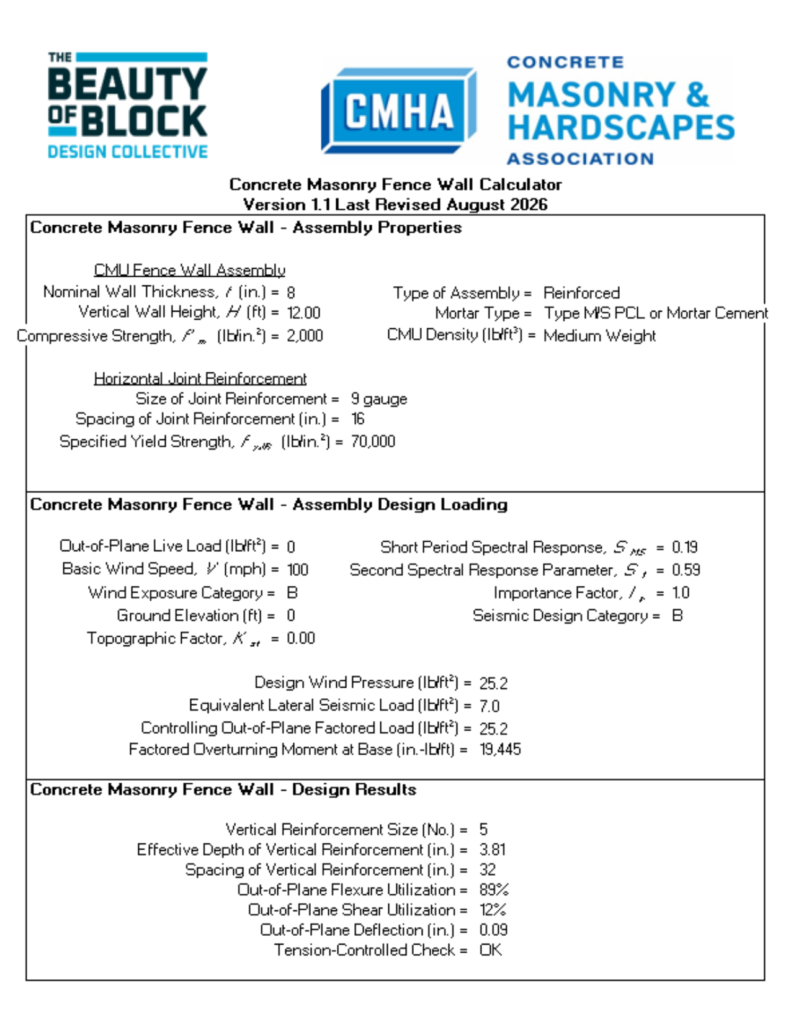
This calculator designs concrete masonry freestanding fence walls in accordance with the strength design provisions of TMS 402/602-22 and the loading criteria of ASCE/SEI 7-22 Chapter 29 for wind loading and Chapter 13 for seismic loading. Loading criteria is based on a uniform loading over wall surface with resultant at mid-height of the assembly. Designs are performed on a normalized per length of wall. Highlighted cells are user inputs. Inputs and outputs use inch-pound units.
Maximizing Partition Wall Efficiency with 6 Inch CMU
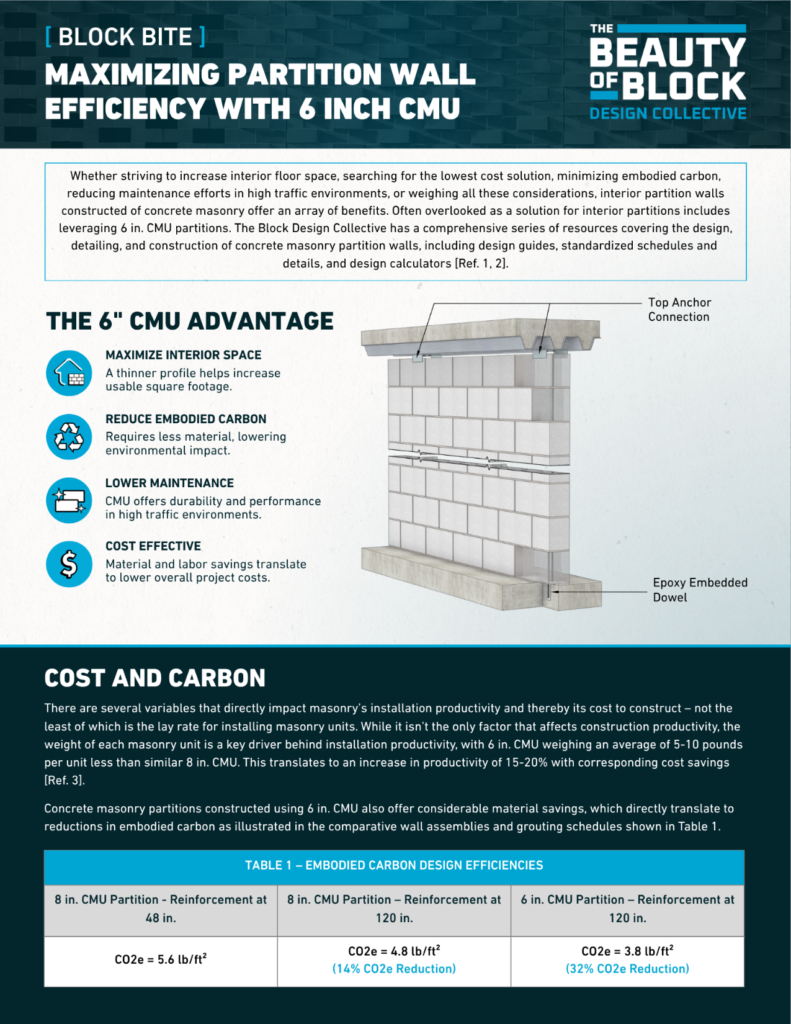
Whether striving to increase interior floor space, searching for the lowest cost solution, minimizing embodied carbon, reducing maintenance efforts in high traffic environments, or weighing all these considerations, interior partition walls constructed of concrete masonry offer an array of benefits. Often overlooked as a solution for interior partitions includes leveraging 6 in. CMU partitions. The Block Design Collective has a comprehensive series of resources covering the design, detailing, and construction of concrete masonry partition walls, including design guides, standardized schedules and
details, and design calculators [Ref. 1, 2].
Concrete Masonry Elevator and Stairwell Building Core Design Guide

In this presentation, we will introduce the “Concrete Masonry Elevator and Stairwell Building Core Design Guide”. This document was recently published by the Concrete Masonry Checkoff Program in collaboration with the Rocky Mountain Masonry Institute (RMMI) and Atkinson-Noland & Associates (ANA). This publication allows a structural engineer to pick out a CMU building core design guide for a low-rise building from tables using geometry and load requirements. Since the guide calculations take advantage of flange behavior per the TMS 402 Code at corners, your core designs will be both simple and efficient. We will talk about both how to use the new guide as well as the assumptions and limitations.
Controlling Cracking and Movement in CMU Structures & Veneers
This presentation introduces concrete masonry by reviewing its aesthetic options, primary sustainability drivers, and common wall assembly types. It explains the main causes of movement and cracking in CMU walls and veneers, including structural loading, excessive deflection, differential settlement, differential movement, and shrinkage. Crack control strategies are considered such as using joint reinforcement, control joints, and relief joints. It concludes with detailing examples for openings, banding, shelf angles, corners, bond beams, and other common locations where movement must be accommodated.
Design and Detailing Guide for Nonloadbearing Concrete Masonry Partition Walls
This guide provides a comprehensive resource for the design and detailing of interior nonloadbearing concrete masonry partition walls, outlining key considerations that influence performance, constructability, and efficiency. It brings together best practices related to fire resistance, sound control, structural behavior, crack control, and connection detailing, while also emphasizing strategies that improve cost-effectiveness and reduce material use. Through a combination of explanatory content and pre-engineered solutions, the guide is intended to support designers in making informed decisions and efficiently incorporating concrete masonry partitions into project documents.
Reinforced 6 In. (SDC D) Detail
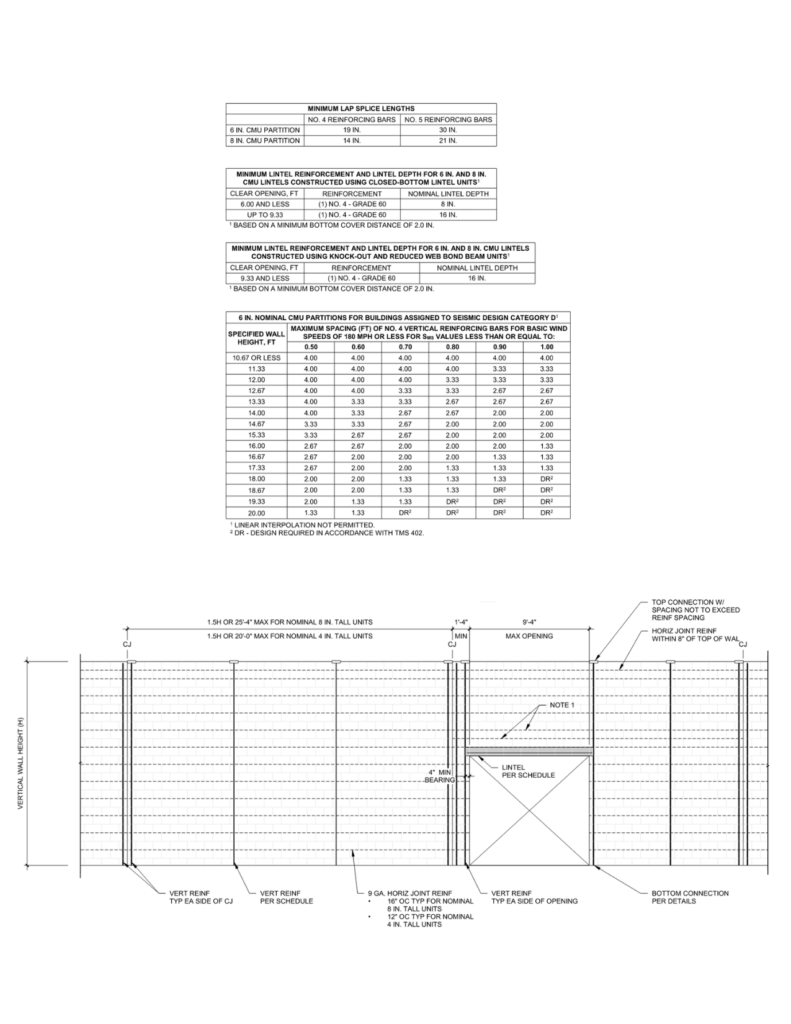
Partition wall detail for 6″ reinforced masonry wall.
Reinforced 6 In. (SDC C) Detail
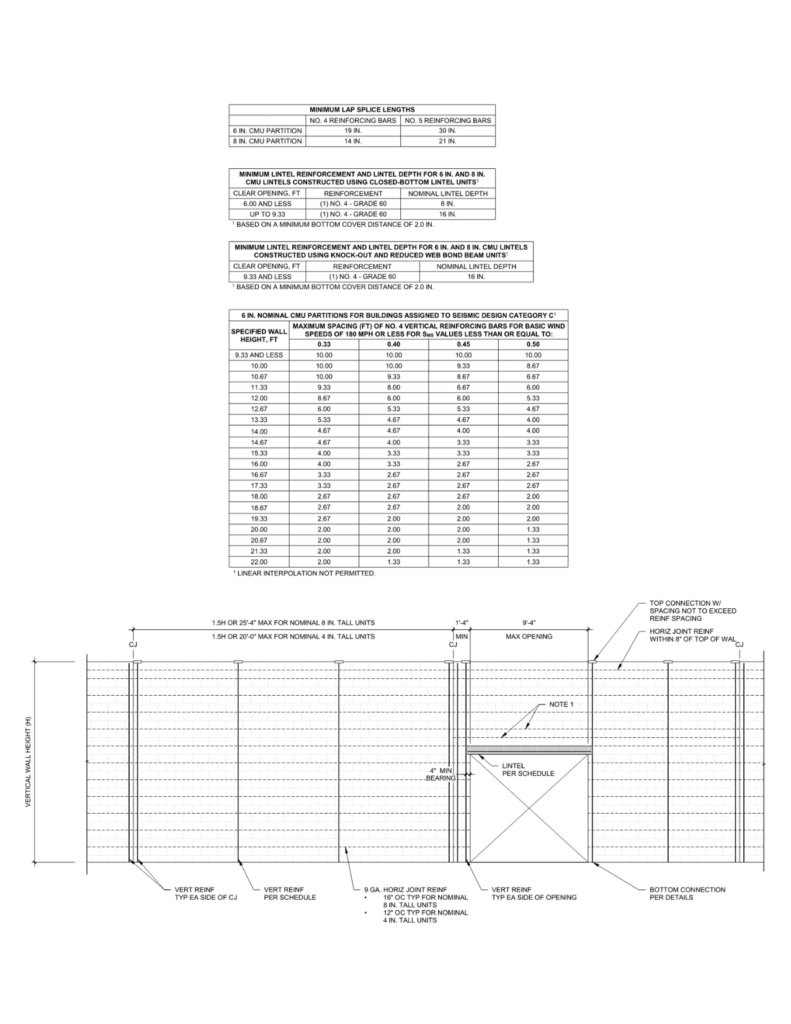
Partition wall detail for 6″ reinforced masonry wall.
Reinforced 6 In. (SDC A or B) Detail
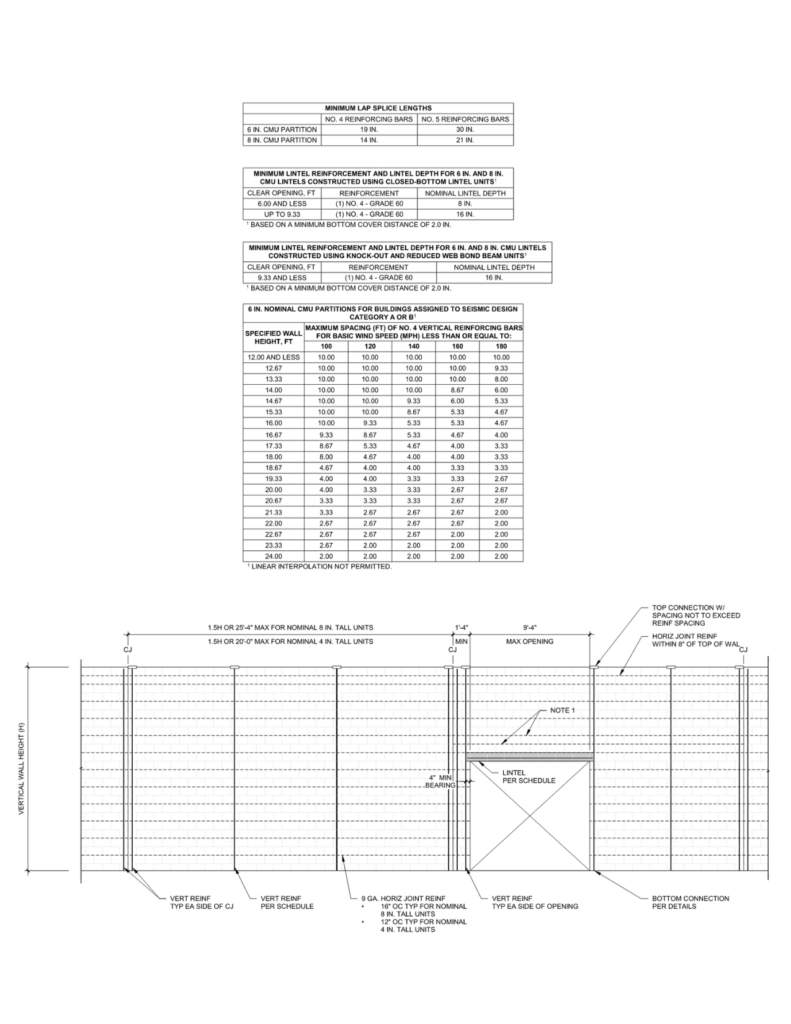
Partition wall detail for 6″ reinforced masonry wall.
