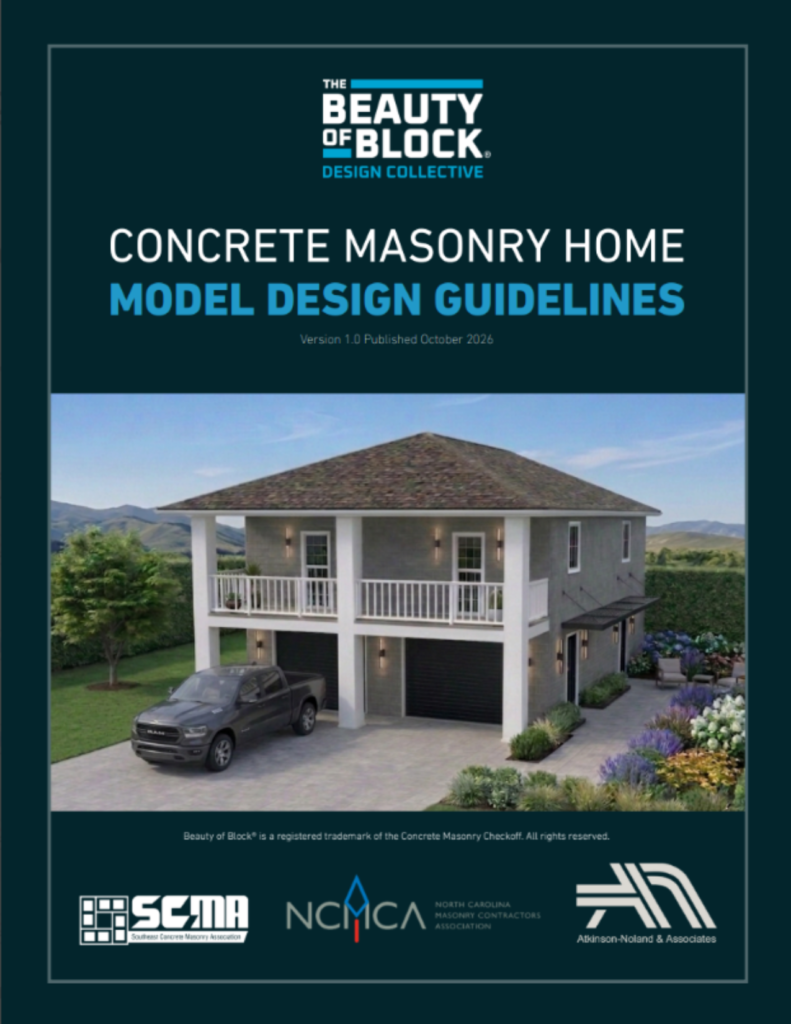
Building a home with concrete masonry construction makes sense. Concrete masonry is attractive, strong, and long-lasting. In this Guide and the accompanying design drawings, the concrete masonry industry supports development of design options to promote concrete masonry unit (CMU) growth in residential markets and also provides homeowners and builders with quality information to assist them in choosing the premier wall system for their residence. The Guidelines also serve to familiarize designers with a typical concrete masonry home design, optimized to meet code requirements while being as cost effective as possible.
Masonry walls fulfill multiple purposes, contributing to overall efficiency and construction cost-effectiveness. These walls deliver structural stability, serve as external weather barriers, offer thermal insulation, and possess a high fire rating that promotes safety and comfort within residential environments. The primary advantages of masonry walls are outlined below.
- Attractive. Smooth-faced blocks deliver a modern, aesthetically pleasing appearance desired for contemporary homes. Concrete masonry units (CMUs) are available in a variety of colors and surface textures, enabling bespoke architectural designs to suit any preference.
- Strong. Reinforced masonry construction offers robust strength and ductility to withstand everyday loads as well as high winds and earthquake forces.
- Durable. Masonry walls have excellent resistance to environmental factors including moisture, freezing temperatures, and thermal extremes, ensuring longevity without frequent repair or replacement. Routine use does not compromise their integrity.
- Sustainable. Concrete masonry units are sourced locally across the United States and composed of natural materials. Their internal pore structure and large surface-area-to-mass ratio facilitate rapid sequestration of atmospheric carbon dioxide compared to other cement-based products.
- Fire resistant. Masonry materials are non-combustible and achieve fire ratings that exceed building code requirements.
- Thermally efficient. CMU construction featuring integral insulation effectively moderates interior temperatures for comfortable living. The high thermal mass of CMU walls stores heat and releases it gradually, reducing heating and cooling demands and increasing energy efficiency.
- Sound minimizing. Concrete masonry walls provide superior sound insulation, exceeding building code requirements for sound transmission and resulting in quieter indoor environments.
- Insect proof. Masonry materials do not provide a food source for termites, ants, or other insect life.
- Mold resistant. Concrete masonry is inorganic and therefore does not support the growth of mold and mildew.
These Guidelines accompany a separate set of design details and serve as a commentary to the model CMU home design, providing background to the design process and information on design alternatives. The base home design is intended to be applicable to design requirements throughout the majority of North Carolina and South Carolina. Design options are provided that consider areas with high design wind speeds, increased seismic demand, and cold climates.