
Screen Wall Calculator
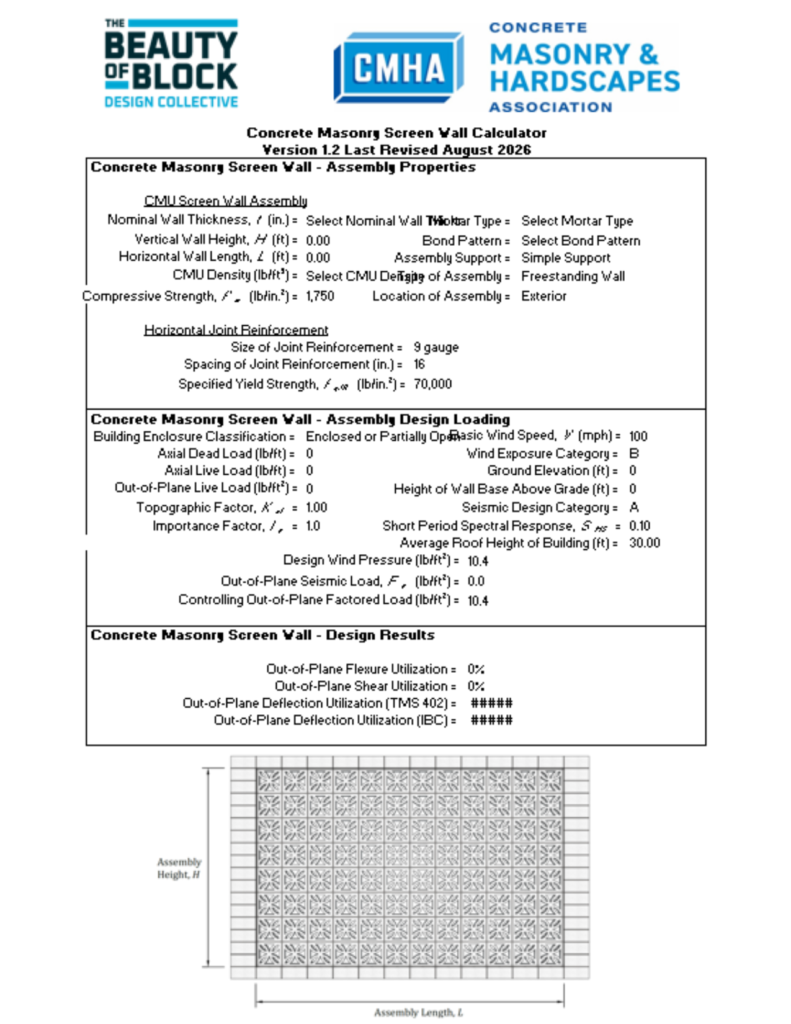
This calculator designs concrete masonry screen walls in accordance with the strength design provisions of TMS 402/602-22 and the loading criteria of ASCE/SEI 7-22 Chapter 28 for interior screen wall assemblies, ASCE/SEI 7 Chapter 29 for exterior screen wall assemblies, and Chapter 13 for seismic loading. Loading criteria is based on a uniform loading over wall surface with resultant at mid-height and mid-length of the assembly. Highlighted cells are user inputs. Inputs and outputs use inch-pound units.
Fence Wall Calculator
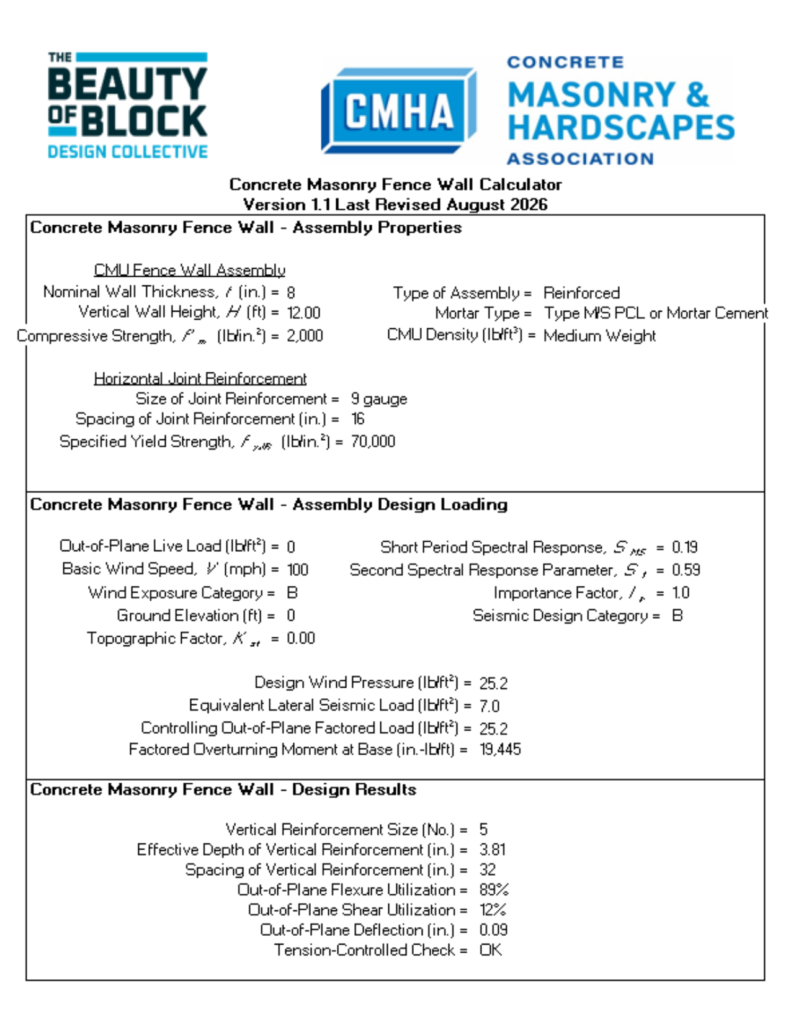
This calculator designs concrete masonry freestanding fence walls in accordance with the strength design provisions of TMS 402/602-22 and the loading criteria of ASCE/SEI 7-22 Chapter 29 for wind loading and Chapter 13 for seismic loading. Loading criteria is based on a uniform loading over wall surface with resultant at mid-height of the assembly. Designs are performed on a normalized per length of wall. Highlighted cells are user inputs. Inputs and outputs use inch-pound units.
Partition Wall Calculator
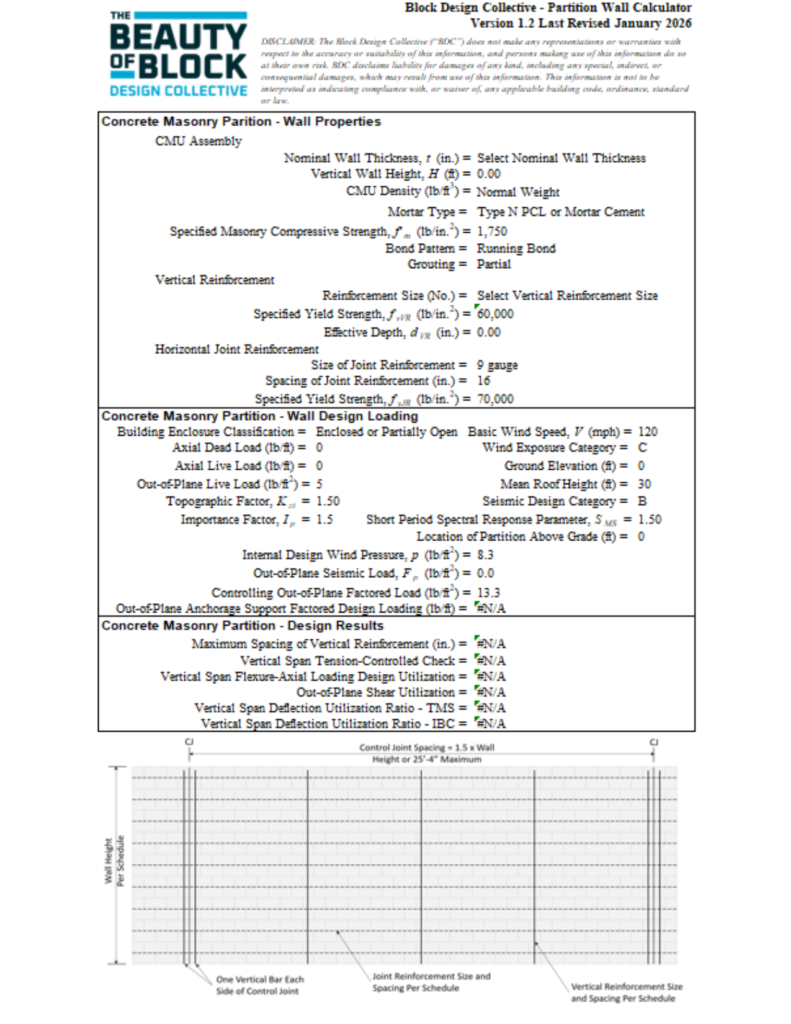
This calculator designs interior concrete masonry partition walls in accordance with the strength design provisions of TMS 402/602-22 and the loading criteria of ASCE/SEI 7-22. Highlighted cells are user inputs. Inputs and outputs use inch-pound units.
Concrete Masonry: From Manufacturing to Structural Applications
This module explores the fundamentals of concrete masonry construction, beginning with the manufacturing process of concrete masonry units (CMUs) and examining both standard gray block and architectural finishes.
Participants will learn about various CMU shapes, sizes, and modular design principles that optimize construction efficiency. The course covers essential structural considerations, including the differences between unit compressive strength and specified masonry assembly strength (f’m), and examines how tall structures can be built using concrete masonry.
Additionally, the module introduces efficient design strategies that help reduce both project costs and embodied carbon, making concrete masonry an economical and sustainable building solution.
Properties and Characteristics in Concrete Masonry Construction
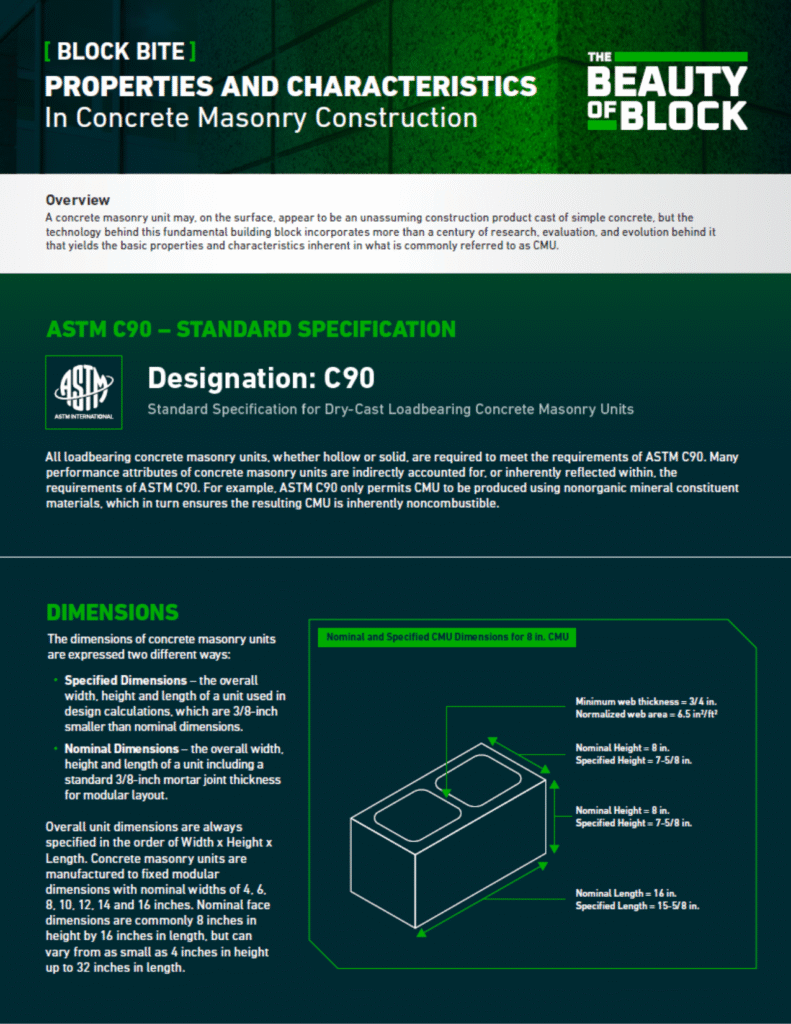
A concrete masonry unit may, on the surface, appear to be an unassuming construction product cast of simple concrete, but the technology behind this fundamental building block incorporates more than a century of research, evaluation, and evolution behind it that yields the basic properties and characteristics inherent in what is commonly referred to as CMU.
Masonry Compressive Strength Calculator
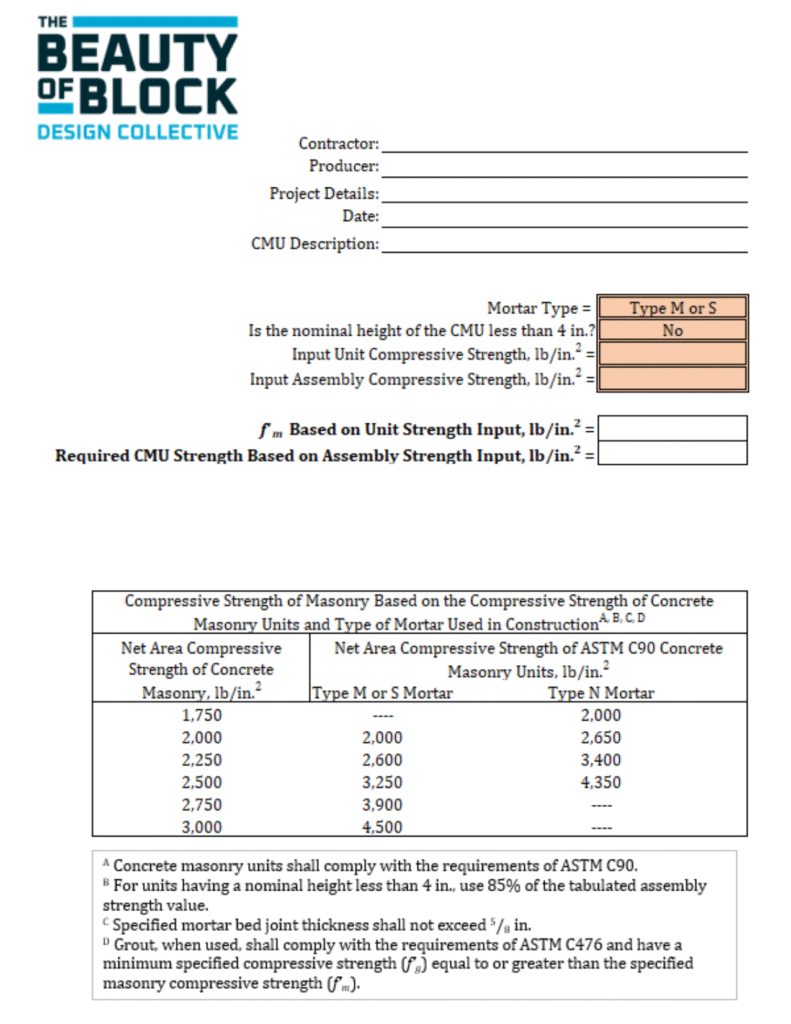
This calculator uses the unit strength table of TMS 602 (shown below) to determine the unit compressive strength required to achieve a user-specified masonry assembly compressive strength (f’m) – or determines the resulting assembly compressive strength (f’m) based on the user defined unit compressive strength. This calculator can be used with either the 2016 or 2022 editions of TMS 402/602.
Section Properties and Wall Weights Calculator
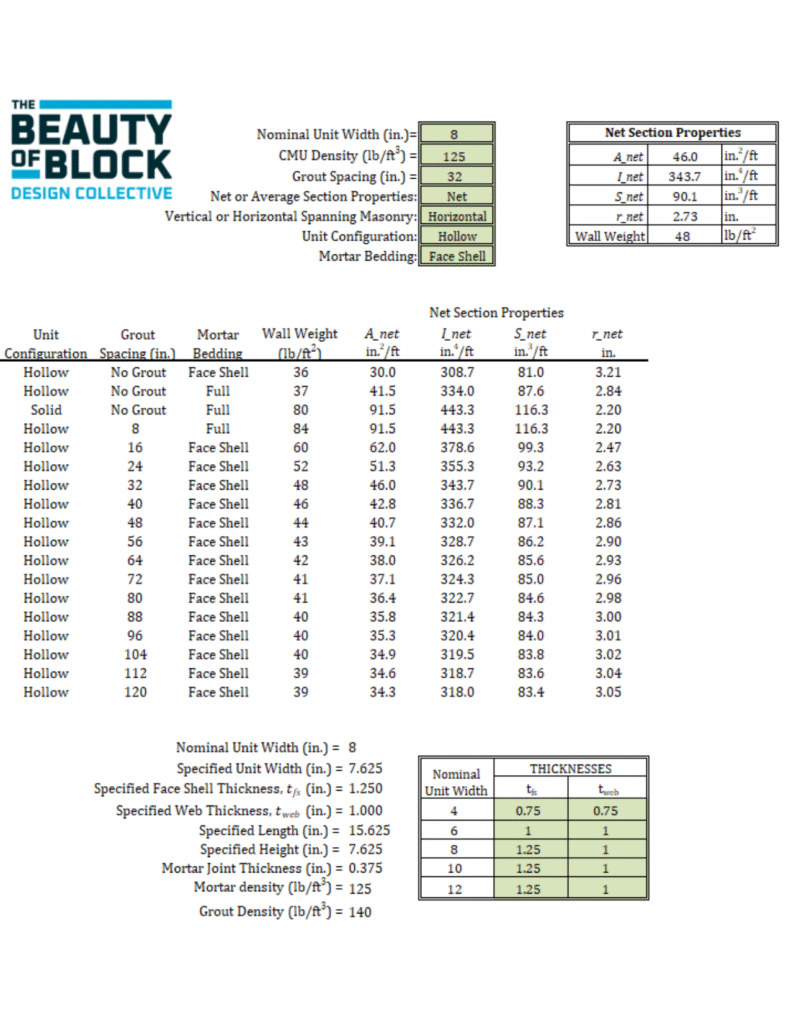
This calculator determines net and average cross-sectional properties based on user defined inputs. Net section properties represent the smallest cross-section of an assembly and are used for calculating assembly strength. Average section properties represent the average cross-section of an assembly and are used for calculating assembly stiffness. This calculator determines the net cross-sectional properties through a plane concurrent with a mortar joint while average section properties are determined through a plane concurrent with the mid-height or mid-length of a unit in the assembly.
Lap Splice & Development Length Calculator
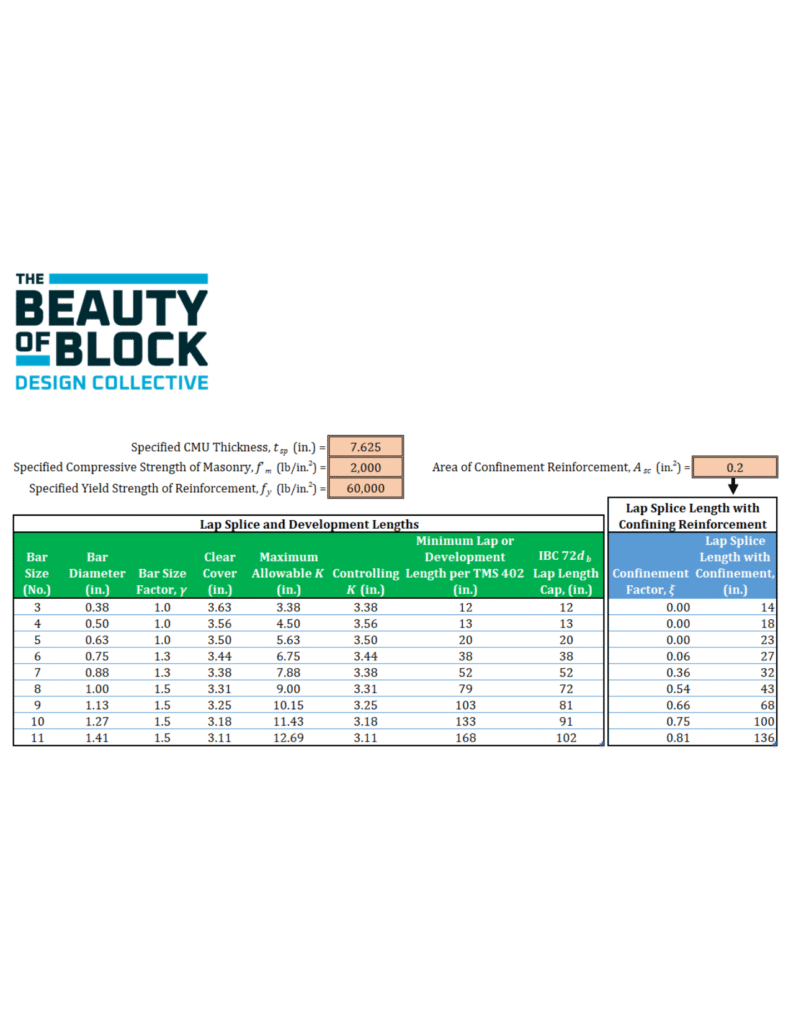
This calculator is based on the provisions of TMS 402/602-16 and TMS 402/602-22, Building Code Requirements and Specification for Masonry Structures. As there is no functional difference between the requirements of these two editions of the masonry design standard pertaining to the determination of minimum lap and development lengths, either edition is applicable.
Sound Transmission Class Ratings for Concrete Masonry Walls
Unwanted noise can be a major distraction, whether at school, work or home. Concrete masonry walls are often used for their ability to isolate and dissipate noise. Concrete masonry offers excellent noise control in two ways. First, it effectively blocks airborne sound transmission over a wide range of frequencies. Second, concrete masonry effectively absorbs noise, thereby diminishing noise intensity. Because of these abilities, concrete masonry has been used successfully in applications ranging from party walls to hotel separation walls, and even highway sound barriers.
Concrete Masonry Unit Shapes, Sizes, Properties, and Specifications
The most widely used standards for specifying concrete masonry units in the United States are published by ASTM International. These ASTM standards contain minimum material and property requirements that assure quality performance. These requirements include items such permitted constituent materials, minimum compressive strength, maximum linear drying shrinkage, maximum absorption, permissible variations in dimensions, and finish and appearance criteria.The letter and first number of an ASTM designation is the fixed designation for that standard. For example, ASTM C90 (REF. 1) is the fixed designation for loadbearing concrete masonry units. The number immediately following indicates the year of last revision (i.e., ASTM C90-16 would be the version of C90 published in 2016). Because significant changes can be introduced into subsequent editions of standards, the edition referenced by the building code or by a project specification is an important consideration when determining specific product requirements. For the discussion presented here, the ASTM requirements reviewed have remained relatively static unless otherwise noted.
