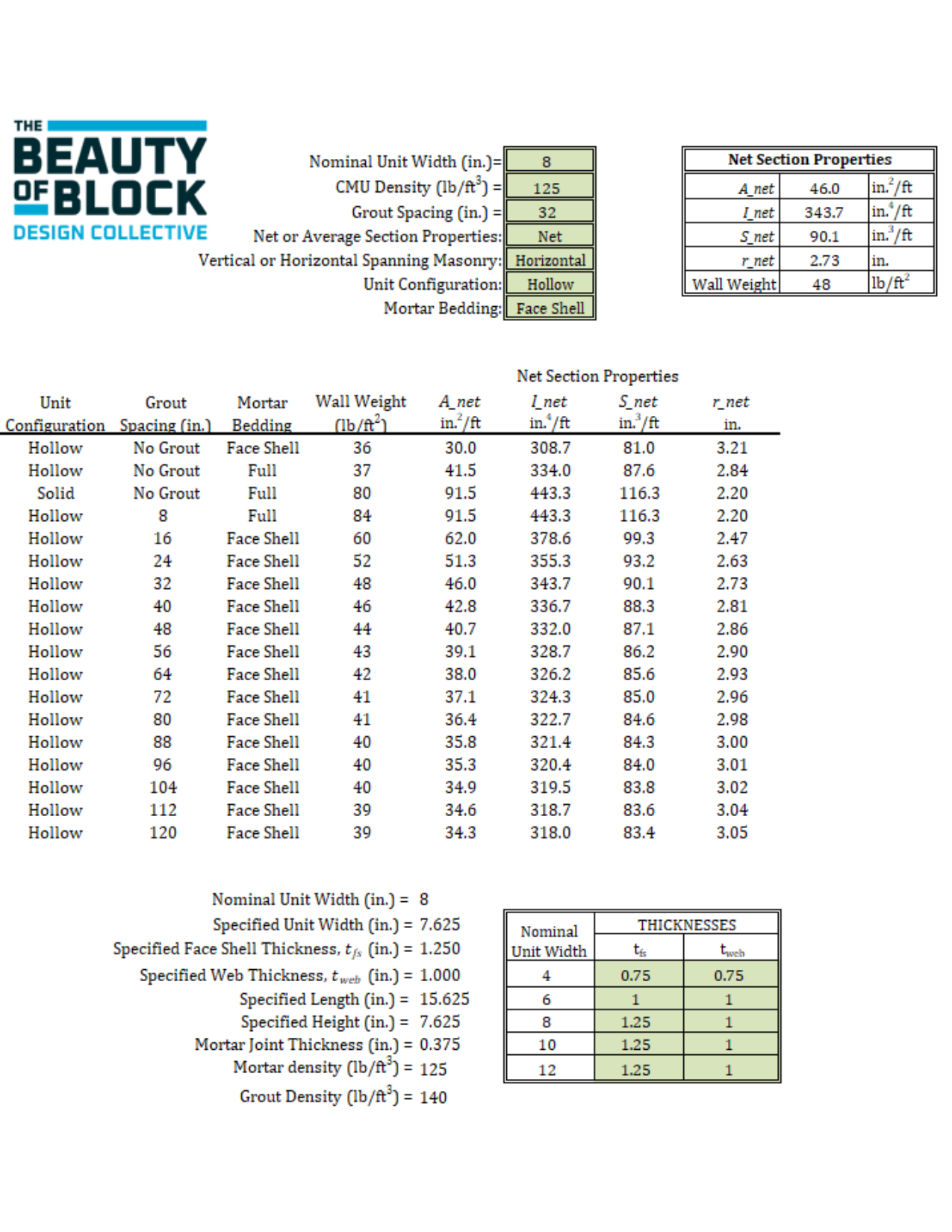
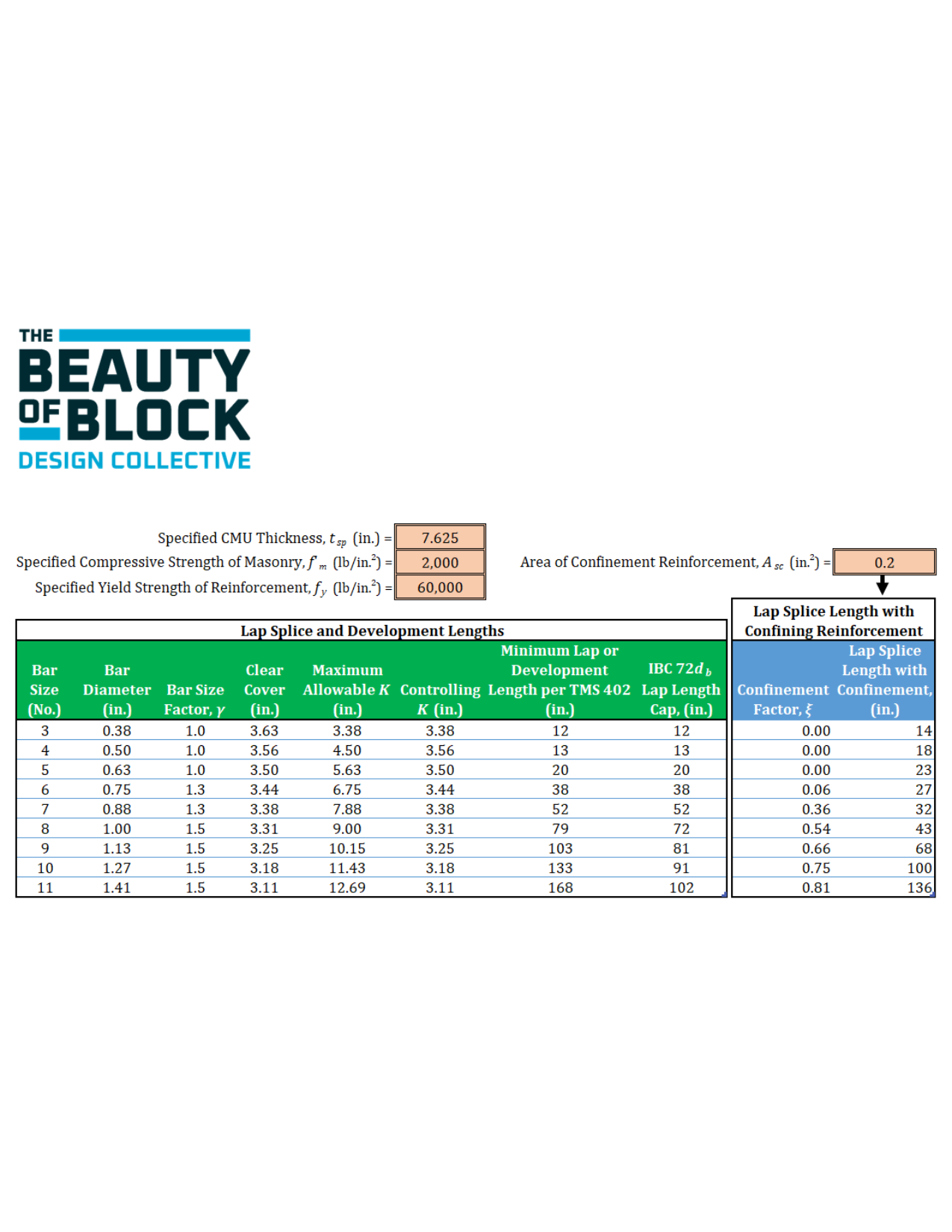
User Notes and Calculator Assumptions
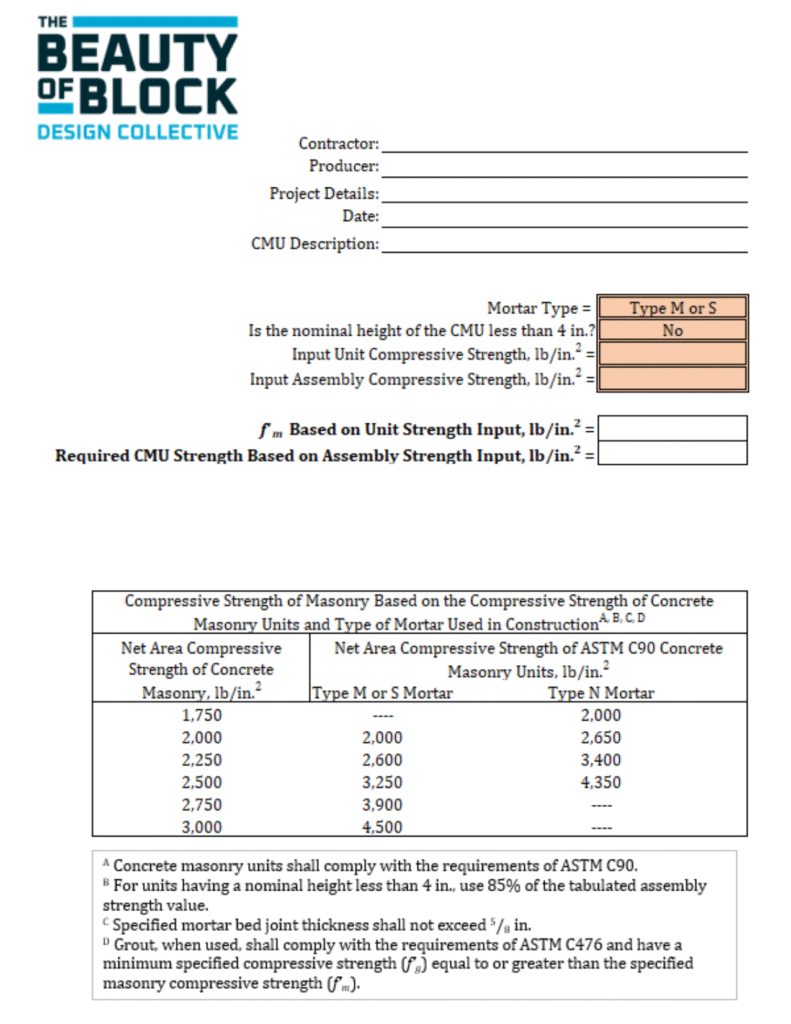
1) This calculator uses the unit strength table of TMS 602 (shown below) to determine the unit compressive strength required to achieve a user-specified masonry assembly compressive strength (f’m) – or – determines the resulting assembly compressive strength (f’m) based on the user defined unit compressive strength. This calculator can be used with either the 2016 or 2022 editions of TMS 402/602.
2) Highlighted cells are user inputs. All inputs and outputs use inch-pound units.
3) The “Unit-Assembly Strength ” sheet allows users to input the following assembly properties:
a) Mortar type
b) Whether the CMU has a nominal height less than 4 in.
c) User-defined compressive strength of the CMU.
d) User-defined compressive strength of the assembly (f’m).
When a user-defined CMU compressive strength is input, the calculator output is the resulting assembly compressive strength (f’m) based on the type of mortar selected. Conversely, when a user-defined assembly compressive strength is defined, the calculator determines the resulting minimum CMU compressive strength required to achieve this assembly strength based on the type of mortar selected. TMS 602 includes a correction factor for converting unit-to-assembly compressive strengths when the nominal unit height is less than 4 in., which is also included in the calculations when the user input indicates a nominal unit height of less than 4 in. is being used.
4) When unit or assembly strength inputs are outside the range of the TMS 602 unit strength table, the resulting output will indicate “Input Out of Range”. The minimum and maximum input range for unit compressive strength is 2,000 lb/in.2 and 4,500 lb/in.2, respectively. The minimum and maximum input range for the assembly compressive strength is 1,750 lb/in.2 and 3,000 lb/in.2, respectively.
5) The unit compressive strength and assembly compressive strength (f’m) quantify different material properties. The compressive strength of the unit is a measurement of only the CMU compressive strength whereas the compressive strength of the assembly includes the contribution of the CMU, mortar, and grout, if present.
6) All loadbearing CMU must meet the minimum requirements of ASTM C90, however, baseline CMU compressive strengths can vary regionally as well as based on the type of CMU being specified (grey CMU vs. architectural CMU). When a specific CMU compressive strength is desired, contact producers or regional organizations in the project area for recommendations on available unit compressive strengths.
Notations
f’g = specified compressive strength of grout, lb/in.2
f’m = specified compressive strength of masonry, lb/in.2
Protection
To prevent the inadvertent changing of this calculator’s functions, many of the cells are locked from editing. Users may unlock the spreadsheet if desired using the password “BDC”.