
Screen Wall Calculator
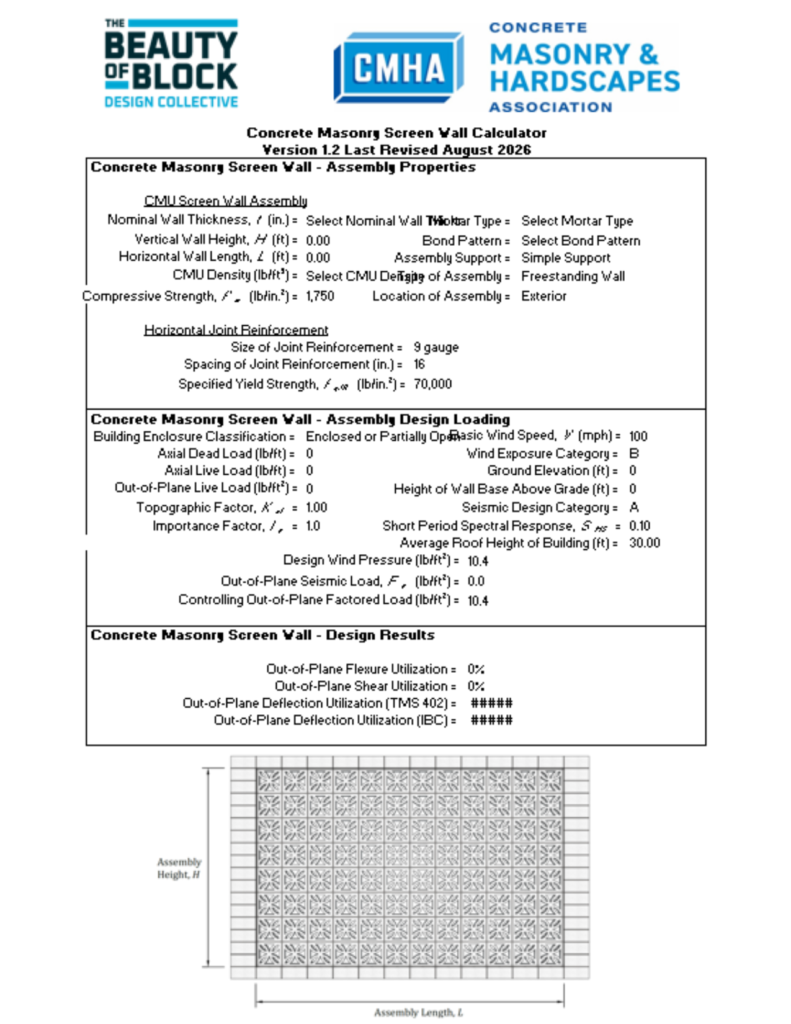
This calculator designs concrete masonry screen walls in accordance with the strength design provisions of TMS 402/602-22 and the loading criteria of ASCE/SEI 7-22 Chapter 28 for interior screen wall assemblies, ASCE/SEI 7 Chapter 29 for exterior screen wall assemblies, and Chapter 13 for seismic loading. Loading criteria is based on a uniform loading over wall surface with resultant at mid-height and mid-length of the assembly. Highlighted cells are user inputs. Inputs and outputs use inch-pound units.
Fence Wall Calculator
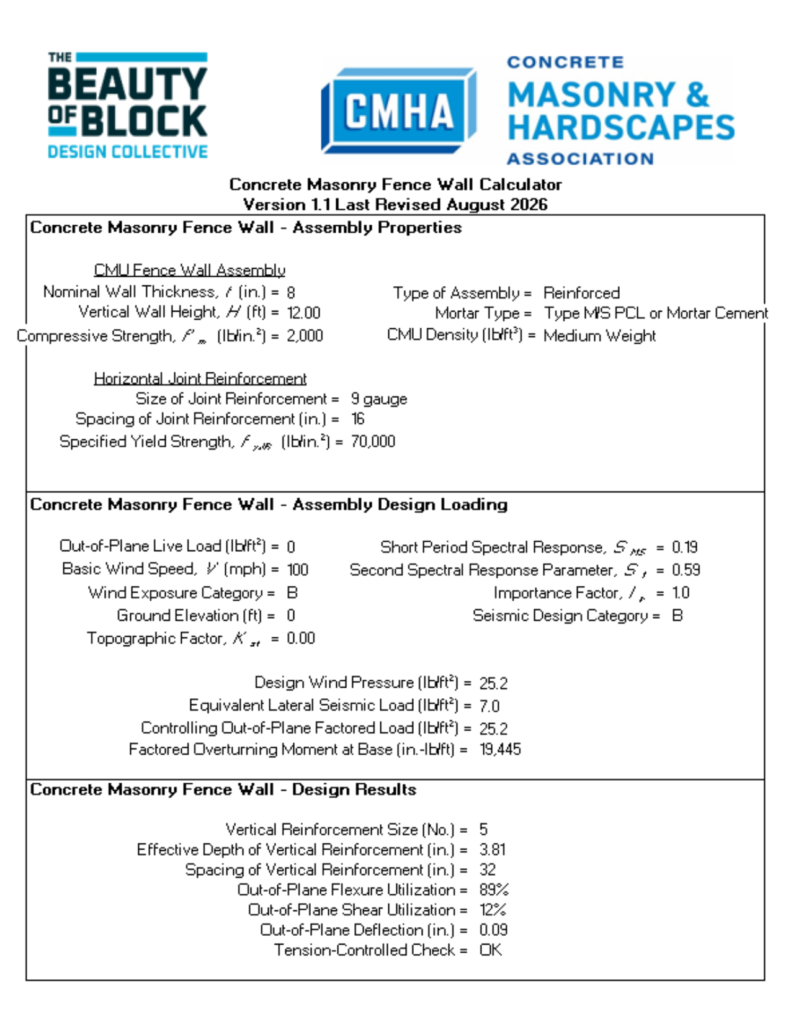
This calculator designs concrete masonry freestanding fence walls in accordance with the strength design provisions of TMS 402/602-22 and the loading criteria of ASCE/SEI 7-22 Chapter 29 for wind loading and Chapter 13 for seismic loading. Loading criteria is based on a uniform loading over wall surface with resultant at mid-height of the assembly. Designs are performed on a normalized per length of wall. Highlighted cells are user inputs. Inputs and outputs use inch-pound units.
Maximizing Partition Wall Efficiency with 6 Inch CMU
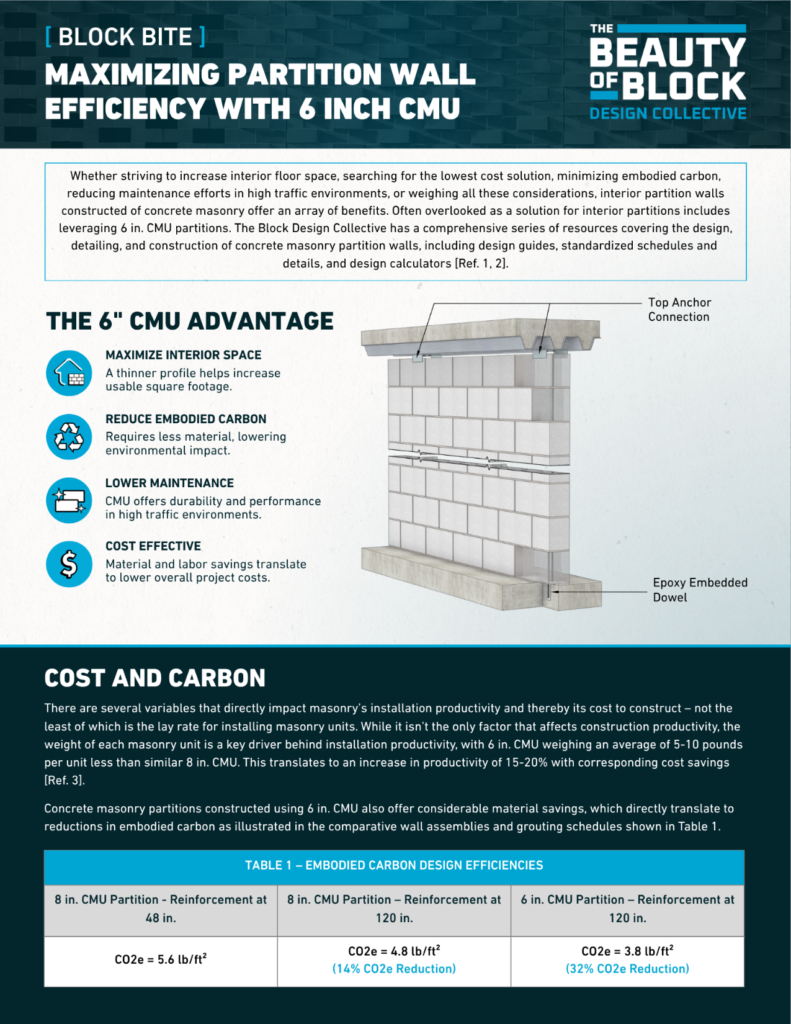
Whether striving to increase interior floor space, searching for the lowest cost solution, minimizing embodied carbon, reducing maintenance efforts in high traffic environments, or weighing all these considerations, interior partition walls constructed of concrete masonry offer an array of benefits. Often overlooked as a solution for interior partitions includes leveraging 6 in. CMU partitions. The Block Design Collective has a comprehensive series of resources covering the design, detailing, and construction of concrete masonry partition walls, including design guides, standardized schedules and
details, and design calculators [Ref. 1, 2].
Built for Learning: Concrete Masonry and Resilient K-12 Schools
This course will provide architects, engineers, and interior designers with the necessary tools to design more resilient K-12 buildings that foster healthier learning environments and safer spaces utilizing concrete masonry. Attendees will learn about structural, acoustic, and fire-resistant properties of CMU while exploring how it impacts first cost, life-cycle costs, and multiple building products and systems. Explore ways masonry will contribute to your sustainability goals through topics like resilience, embodied carbon, and carbon sequestration.
Controlling Cracking and Movement in CMU Structures & Veneers
This presentation introduces concrete masonry by reviewing its aesthetic options, primary sustainability drivers, and common wall assembly types. It explains the main causes of movement and cracking in CMU walls and veneers, including structural loading, excessive deflection, differential settlement, differential movement, and shrinkage. Crack control strategies are considered such as using joint reinforcement, control joints, and relief joints. It concludes with detailing examples for openings, banding, shelf angles, corners, bond beams, and other common locations where movement must be accommodated.
Architectural Concrete Masonry: Single-Wythe Walls
This course introduces the design and performance fundamentals of architectural single-wythe concrete masonry. Participants will explore how concrete masonry’s inherent durability, resilience, thermal mass, and low-embodied-carbon contribute to high-performing building envelopes. The program explains key strategies for moisture management—including surface protection, integral water repellents, flashing, weeps, and crack-control detailing to keep single-wythe CMU walls dry and long-lasting. Learners will examine energy-code compliance pathways for mass walls, insulation options, and how density, thermal mass, and assembly configuration influence energy performance. The course concludes with practical guidance on air and vapor barriers, utilities, sample panels, and cleaning procedures to ensure high-quality outcomes in architectural CMU projects.
Architectural Concrete Masonry: Veneers & Cavity Walls

Architectural concrete masonry anchored veneers combine beauty, durability, and low maintenance while offering architects significant design flexibility. This course examines the finishes, sizes, profiles, and colors that distinguish architectural CMU, and explores the high performance these systems achieve when coupled with concrete masonry cavity walls. Participants will review essential detailing recommendations for veneers, including how to accommodate openings, flashing, anchoring, and crack control strategies. The session also covers energy performance benefits, thermal mass advantages, and cavity wall insulation strategies, while emphasizing quality assurance through sample panels. The course finishes with discussing cleaning recommendations for architectural masonry.
Climate-Responsive Design: Balancing Resilience, Thermal Performance and Embodied Carbon with Concrete Masonry
This course explores how using concrete masonry units (CMU) in the built environment provides an integrated approach to climate-responsive design by simultaneously addressing three critical sustainability strategies: resilience, operational energy use, and embodied carbon reduction. Participants will examine how CMU construction offers inherent solutions to modern building challenges, from natural disasters and extreme weather events to energy conservation and carbon footprint reduction. The course demonstrates that CMU structures perform beyond code requirements without additional measures, providing durable, cost-effective buildings that support community resilience while contributing to low embodied carbon goals.
General Design of Concrete Masonry Structures
This course explores the required concrete masonry design considerations to ensure a fully designed wall system that adheres to structural, fire, acoustic and energy design. The structural consideration will include the basis of design parameters, applications, design considerations, elemental design and limit states. While structural design is important, the course will discuss our ensuring fire, acoustical and energy compliance must also fit into the requirements of the wall system.
Maximizing Concrete Masonry Performance Through Structural Design

This course will cover various design components of efficient structural masonry design. It is intended to help the audience understand the implications of structural design solutions and their impact on masonry performance. The goal is to offer actionable recommendations and standards that promote efficient, cost-effective masonry solutions.
