Effective moisture control in concrete masonry unit (CMU) walls requires the integration of quality materials, precise detailing and proper workmanship. The coordinated use of Integral Water Repellents (IWR) in both block and mortar, along with flashing, weeps, joint tooling, and breathable coatings, prevents water intrusion, promotes drying and ensures long-term durability.
Moisture management is not a single product but a system that must be specified and constructed correctly.
WHY MOISTURE CONTROL MATTERS
Moisture control is a critical part of every wall system. Moisture by itself has no detrimental impact on concrete masonry; however, excessive moisture that is allowed to accumulate within a masonry assembly can cause issues.
Proper moisture control leads to:
- Less maintenance
- Consistent aesthetics
- Long-term durability
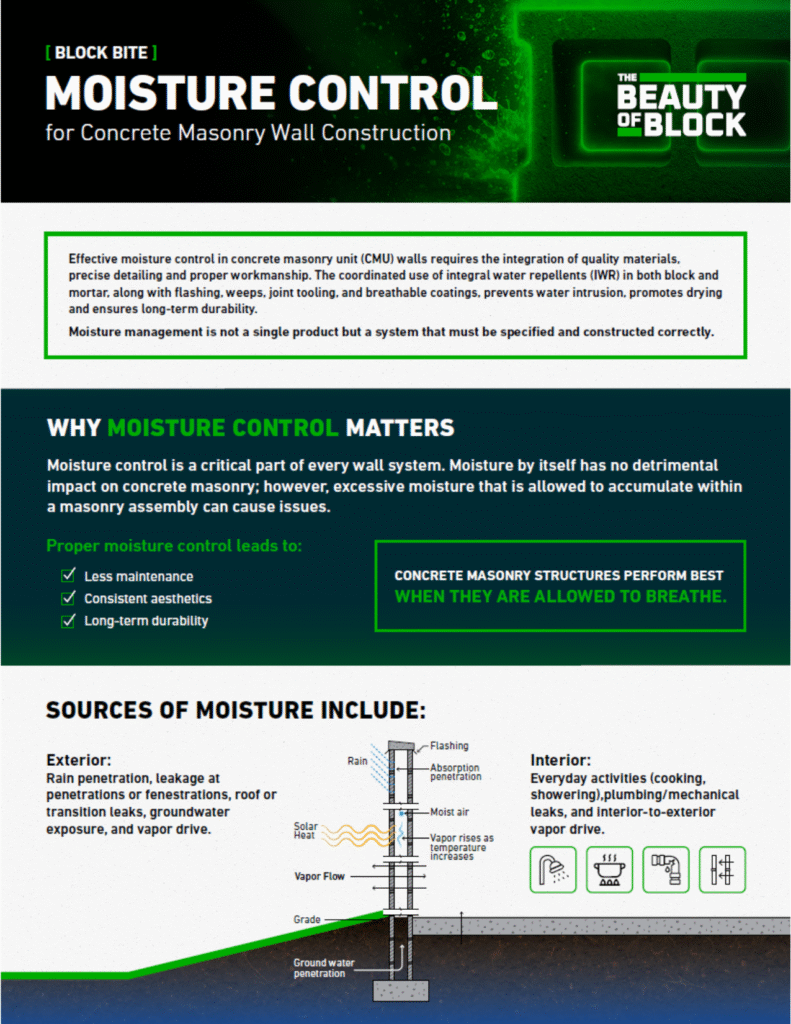
- Exterior: Rain penetration, leakage at penetrations or fenestrations, roof or transition leaks, groundwater exposure, and vapor drive.
- Interior: Everyday activities (cooking, showering), plumbing/mechanical leaks, and interior-to-exterior vapor drive.
KEY MOISTURE CONTROL STRATEGIES
- Single-Wythe Systems: Rely on wall thickness, Integral Water Repellent (IWR) and vapor-permeable coatings (When IWR is needed, it should always be specified in both the block AND the mortar, ensuring uniform performance.
- Multi-Wythe Systems: Includes drainage cavities that are detailed to collect and divert moisture to the exterior.
For exterior surfaces, always use breathable surface treatments to allow any moisture on the inside of the wall to evaporate.
WORKMANSHIP CONSIDERATIONS
Quality installation is as important as design. Common failures stem from poor execution.
- Joint Tooling: Concave or V-shaped profiles compact mortar, reduce porosity and resist water penetration.
- Mortar Stops: Prevent clogging of weeps by catching debris, allowing other moisture control features to operate as intended.
- Mortar Coverage: Mortar bed and head joints should cover the entire area of the face shell thickness. Incomplete mortar joints create pathways for water to enter the wall system.
Best practice for CMU moisture control: Do not add unnecessary membranes (WRB, air barrier, vapor barrier, finishes, etc.) or finishes, as too many layers can trap moisture within the assembly.