A concrete masonry unit may, on the surface, appear to be an unassuming construction product cast of simple concrete, but the technology behind this fundamental building block incorporates more than a century of research, evaluation, and evolution behind it that yields the basic properties and characteristics inherent in what is commonly referred to as CMU.
ASTM C90: STANDARD SPECIFICATION
Designation: C90
Standard Specification for Dry-Cast Loadbearing Concrete Masonry Units
All loadbearing concrete masonry units, whether hollow or solid, are required to meet the requirements of ASTM C90. Many performance attributes of concrete masonry units are indirectly accounted for, or inherently reflected within, the requirements of ASTM C90. For example, ASTM C90 only permits CMU to be produced using nonorganic mineral constituent materials, which in turn ensures the resulting CMU is inherently noncombustible.
DIMENSIONS
The dimensions of concrete masonry units are expressed two different ways:
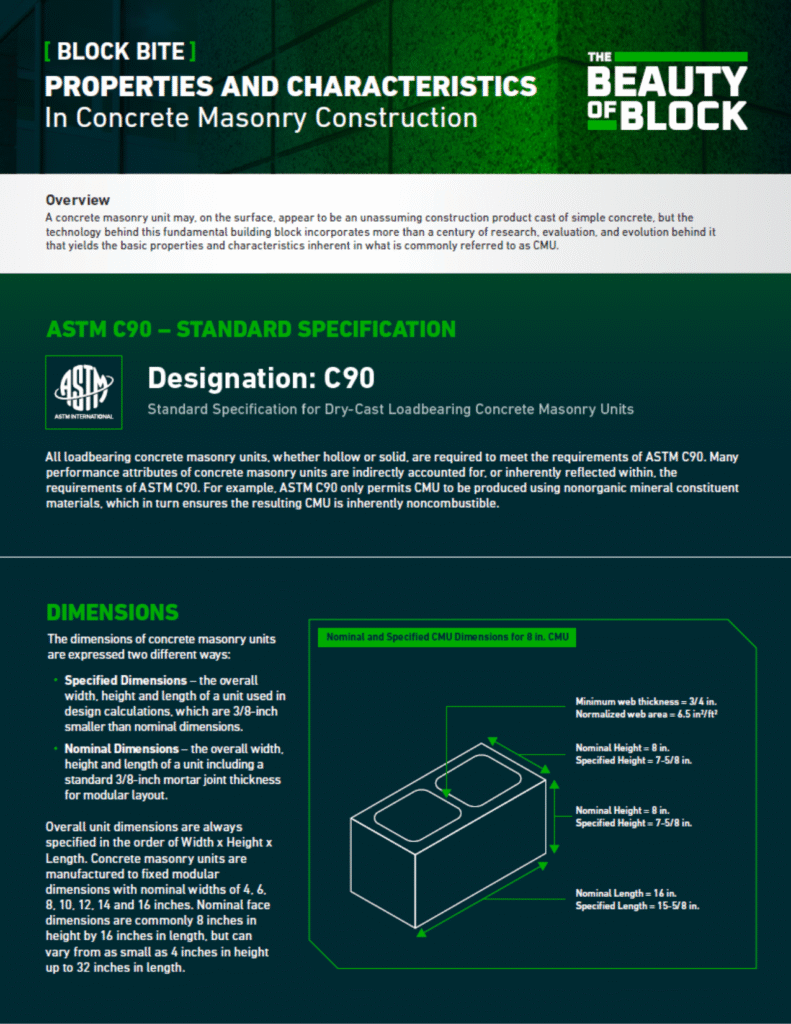
- Specified Dimensions – the overall width, height and length of a unit used in design calculations, which are 3/8-inch smaller than nominal dimensions.
- Nominal Dimensions – the overall width, height and length of a unit including a standard 3/8-inch mortar joint thickness for modular layout.
Overall unit dimensions are always specified in the order of Width x Height x Length. Concrete masonry units are manufactured to fixed modular dimensions with nominal widths of 4, 6, 8, 10, 12, 14 and 16 inches. Nominal face dimensions are commonly 8 inches in height by 16 inches in length, but can vary from as small as 4 inches in height up to 32 inches in length.
COMPRESSIVE STRENGTH
The minimum average compressive strength for CMU is 2,000 lb/in2, which is appropriate for most common applications of concrete masonry construction. There are, however, scenarios when a higher compressive strength may be necessary to resist design loads. All loadbearing CMU must meet this minimum requirement regardless of the configuration of the CMU, its compressive strength, density or other attributes.
DENSITY
Concrete masonry units are classified in three different densities: normal weight, medium weight and lightweight. Structurally, the design of all unit density classes is identical, other than the weight of the individual units changing with changes in density. There are, however, implications for other performance attributes. As the density of a CMU decreases, the fire-resistance rating and energy efficiency increases. Conversely, as the density of a CMU decreases, the sound transmission class of the assembly also decreases.