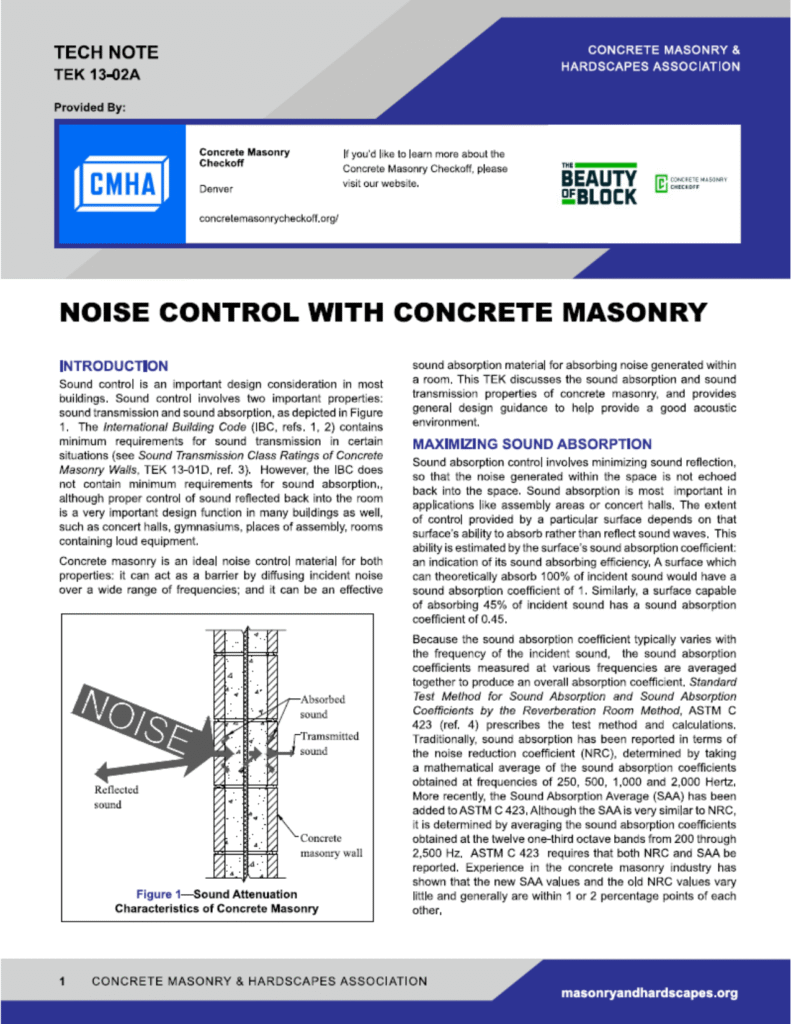
Sound control is an important design consideration in most buildings. Sound control involves two important properties: sound transmission and sound absorption, as depicted in Figure 1. The International Building Code (IBC, refs. 1, 2) contains minimum requirements for sound transmission in certain situations (see Sound Transmission Class Ratings of Concrete Masonry Walls, TEK 13-01D, ref. 3). However, the IBC does not contain minimum requirements for sound absorption, although proper control of sound reflected back into the room is a very important design function in many buildings as well, such as concert halls, gymnasiums, places of assembly, rooms containing loud equipment.
Concrete masonry is an ideal noise control material for both properties: it can act as a barrier by diffusing incident noise over a wide range of frequencies; and it can be an effective sound absorption material for absorbing noise generated within a room. This TEK discusses the sound absorption and sound transmission properties of concrete masonry, and provides general design guidance to help provide a good acoustic environment.