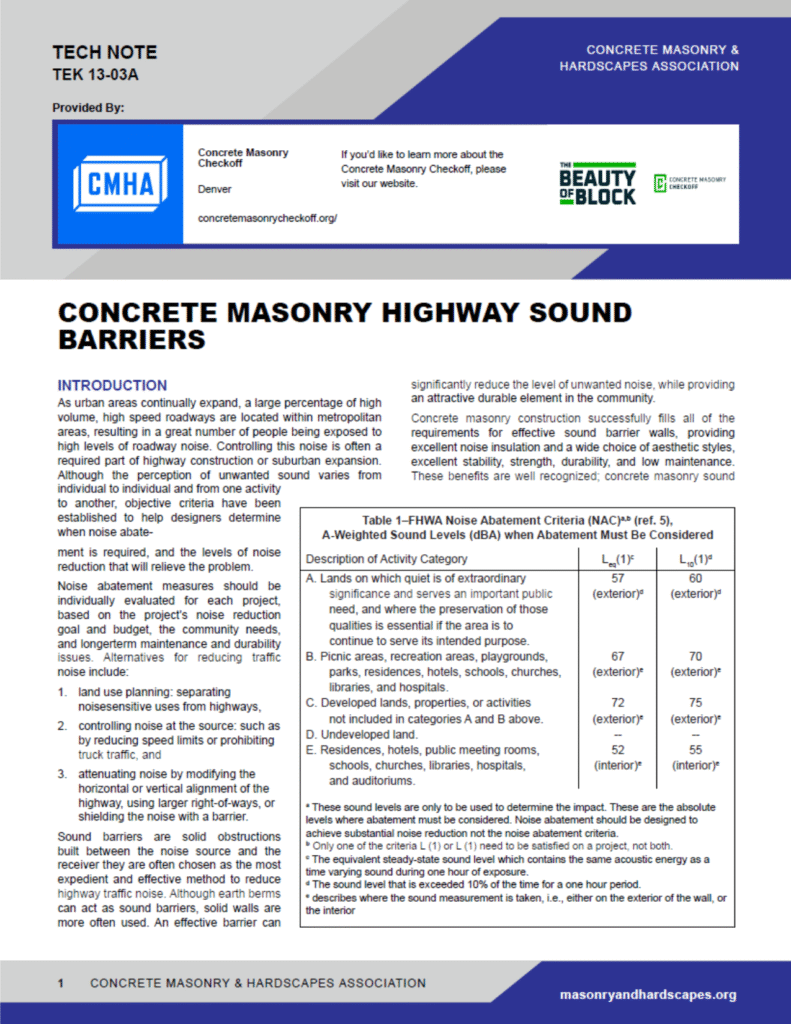
As urban areas continually expand, a large percentage of high volume, high speed roadways are located within metropolitan areas, resulting in a great number of people being exposed to high levels of roadway noise. Controlling this noise is often a required part of highway construction or suburban expansion. Although the perception of unwanted sound varies from individual to individual and from one activity to another, objective criteria have been established to help designers determine when noise abatement is required, and the levels of noise reduction that will relieve the problem.
Noise abatement measures should be individually evaluated for each project, based on the project’s noise reduction goal and budget, the community needs, and longer-term maintenance and durability issues. Alternatives for reducing traffic noise include:
- land use planning: separating noise-sensitive uses from highways,
- controlling noise at the source: such as by reducing speed limits or prohibiting truck traffic, and
- attenuating noise by modifying the horizontal or vertical alignment of the highway, using larger right-of-ways, or shielding the noise with a barrier.
Sound barriers are solid obstructions built between the noise source and the receiver – they are often chosen as the most expedient and effective method to reduce highway traffic noise. Although earth berms can act as sound barriers, solid walls are more often used. An effective barrier can significantly reduce the level of unwanted noise, while providing an attractive durable element in the community.
Concrete masonry construction successfully fills all of the requirements for effective sound barrier walls, providing excellent noise insulation and a wide choice of aesthetic styles, excellent stability, strength, durability, and low maintenance. These benefits are well recognized; concrete masonry sound barriers represent over five times the wall area than the next popular choice, wood post and plank (ref. 4).
This TEK covers acoustic requirements for concrete masonry highway sound barriers. For structural design considerations, the reader is referred to Allowable Stress Design of Pier and Panel Highway Sound Barrier Walls (refs. 3).