CAUSES OF DEFORMATION
Environmental Factors
- Changes in moisture/humidity
- Temperature fluctuations
Structural Loading
- Wind
- Snow
- Building occupants
- Earthquake
Differential Support
Having a portion of a wall supported by a beam and an adjacent portion of the same wall supported by the foundation
Long-Term Shrinkage
The minute loss of volume of a construction material
CODE REQUIREMENTS ADDRESSING LONG-TERM SHRINKAGE
For concrete masonry construction, existing codes and standards specifically address deflection limits and serviceability requirements for structural loading conditions to mitigate cracking. These documents do not, however, require prevention of cracking due to long-term shrinkage, only that it be considered. Instead, industry recommendations have been established to mitigate shrinkage-related cracking.
“Consideration shall be given to e ffects of forces and deformations due to prestressing, vibrations, impact, shrinkage, expansion, temperature changes, creep, unequal settlement of supports, and diff erential movement.” TMS 402 Requirements for Crack Control – Section 4.1.5
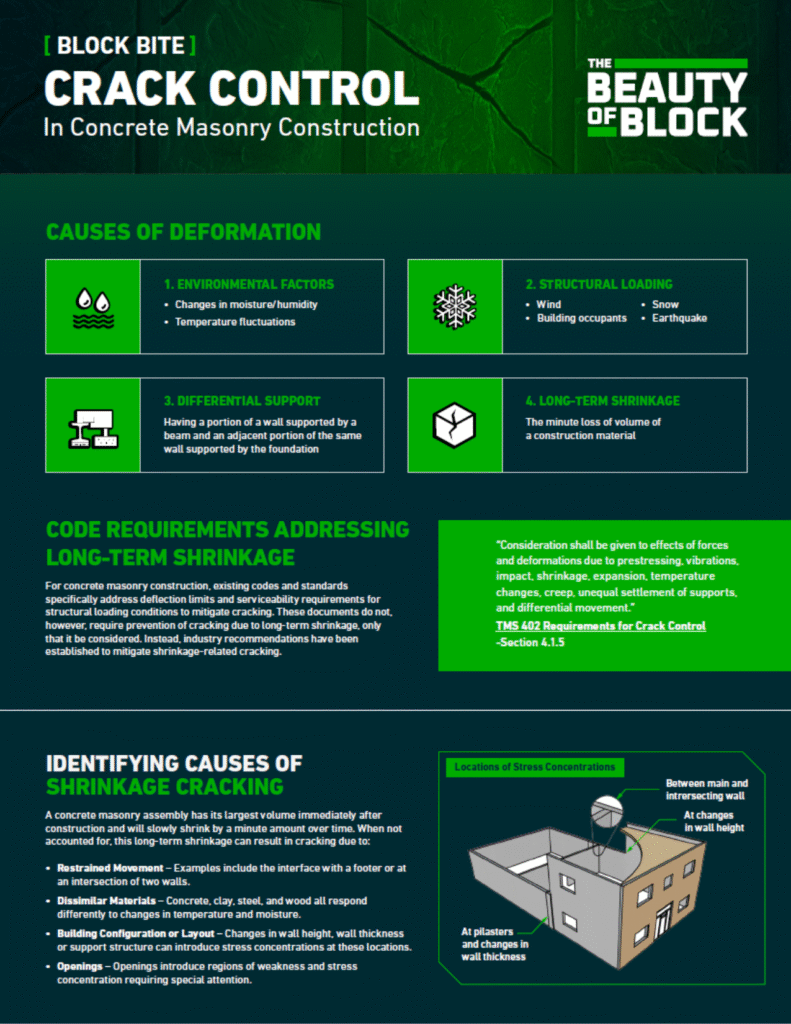
IDENTIFYING CAUSES OF SHRINKAGE CRACKING
A concrete masonry assembly has its largest volume immediately after construction and will slowly shrink by a minute amount over time. When not accounted for, this long-term shrinkage can result in cracking due to:
- Restrained Movement – Examples include the interface with a footer or at an intersection of two walls.
- Dissimilar Materials – Concrete, clay, steel, and wood all respond differently to changes in temperature and moisture.
- Building Configuration or Layout – Changes in wall height, wall thickness or support structure can introduce stress concentrations at these locations.
- Openings – Openings introduce regions of weakness and stress
concentration requiring special attention.
INDUSTRY BEST PRACTICES FOR MITIGATING SHRINKAGE-RELATED CRACKING
The key components to mitigating shrinkage-related cracking in concrete masonry construction involves:
- Identifying areas of a structure where stress concentrations, and therefore cracking, are likely to occur.
- Incorporating control joints or relief joints to allow the structure to move without cracking.
- Detailing horizontal reinforcement to distribute tension stresses that can lead to cracking.
Control joints and relief joints are intentionally weakened sections that allow segments of masonry to move independently and relieve stress concentrations. Working in conjunction with these joints, the horizontal reinforcement distributes the internal tension stresses that develop as a result of shrinkage.
WHO IS RESPONSIBLE FOR LOCATING AND DETAILING CONTROL JOINTS?
The design team is responsible for detailing the type of control joint(s) to use and their locations because there are secondary implications that may need to be taken into account. These may include whether a control joint must be fire-rated as well as the impact on the strength of the assembly, which is influenced by the control joint locations. Depending on whether a concrete masonry assembly is a structural or architectural component of a building will dictate whether it is the structural engineer or architect, respectively, making these detailing decisions.