Masonry construction has been around for millennia, and while masonry’s core attribute remains a handcrafted form of construction, there have been countless innovations through the decades covering all aspects of constituent materials, manufacturing technology, and design modeling that offer an array of efficiencies compared to how we designed and constructed masonry in past generations.
1. LAYOUT EFFICIENCIES
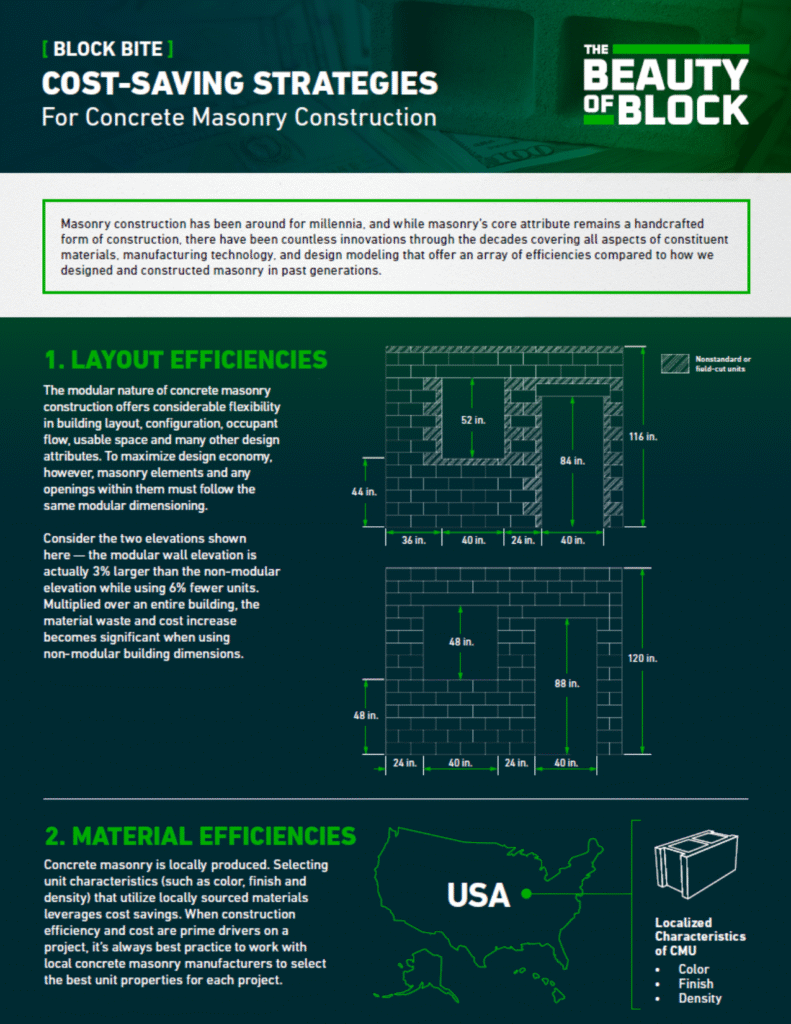
The modular nature of concrete masonry construction offers considerable flexibility in building layout, configuration, occupant flow, usable space and many other design attributes. To maximize design economy, however, masonry elements and any openings within them must follow the same modular dimensioning.
Consider the two elevations shown here — the modular wall elevation is actually 3% larger than the non-modular elevation while using 6% fewer units. Multiplied over an entire building, the material waste and cost increase becomes significant when using non-modular building dimensions.
2. MATERIAL EFFICIENCIES
Concrete masonry is locally produced. Selecting unit characteristics (such as color, finish and density) that utilize locally sourced materials leverages cost savings. When construction efficiency and cost are prime drivers on a project, it’s always best practice to work with local concrete masonry manufacturers to select the best unit properties for each project.
3. DESIGN EFFICIENCIES
- Use joint reinforcement vs. bond beams — Unless bond beams are structurally necessary (such as in high seismic applications), joint reinforcement will always be the less costly alternative to reinforced bond beams. Not only is there savings in grout and reinforcement when using joint reinforcement, but bond beams slow construction productivity.
- Understand distinction of masonry vs. concrete designs and details — While reinforced concrete masonry and reinforced concrete share many similar attributes, they are designed and detailed differently using different standards (TMS 402 for masonry and typically ACI 318 for concrete), each tailored to each system’s strength, performance and method of construction. Applying concrete detailing practices to masonry construction offers no design benefit if not recognized by TMS 402.
- Use appropriate baseline compressive strength — The majority of typical concrete masonry structures can be designed using the baseline assembly strength of 2,000 psi. In some areas of the country, higher-strength CMUs may be readily available and can offer some design efficiencies when accounted for; however, designers should be sure to check with local manufacturers before specifying strengths greater than 2,000 psi. Overspecifying the compressive strength of the masonry can add cost and also raise the embodied carbon of the structure due to the increased cement content of higher strength units.
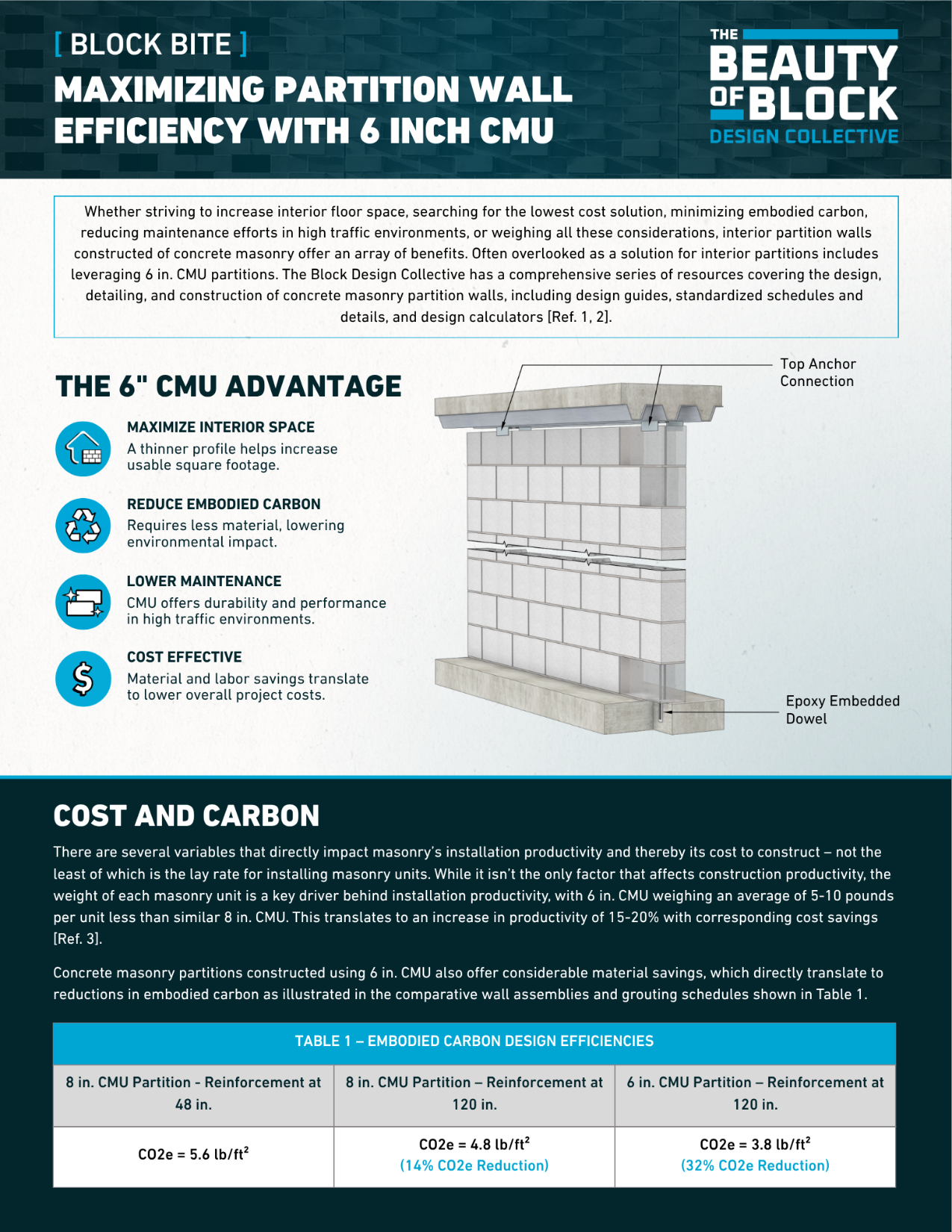
- Maximize reinforcement spacing — There is a common misconception that the spacing of reinforcing steel in concrete masonry construction cannot exceed 48 inches; however, this is not an absolute limit on steel spacing. Consider a typical partition wall that has vertical reinforcement spaced at 48 inches on center. A more efficient design could see spacing the vertical steel out to 120 inches on center for most applications other than high seismic. An even more efficient design would use 6-inch CMU instead of 8-inch CMU, which can also be designed for typical interior partition loads while maintaining a steel spacing of 120 inches. Not only does this save on materials and labor, but the embodied carbon of each of these scenarios is also significantly reduced.